

Chemical Thermodynamics: Principles and Applications
J. Bevan Ott,Juliana Boerio-Goates
2000
View book

Book guide and evaluation
G. Lebon,D. Jou,J. Casas-Vázquez (auth.)
0 reviews
Published
pages
views
Introduction to 'Understanding Non-equilibrium Thermodynamics: Foundations, Applications, Frontiers' Discover the intricate world of non-equilibrium thermodynamics with our comprehensive guide designed to bridge the gap between theory and application. Whether you're a stud
Before you read
Discover the intricate world of non-equilibrium thermodynamics with our comprehensive guide designed to bridge the gap between theory and application. Whether you're a student, researcher, or a professional in the field, this book provides a crucial foundation for understanding the dynamics that govern complex systems far from equilibrium.
“Understanding Non-equilibrium Thermodynamics: Foundations, Applications, Frontiers” is an essential text that delves deep into the principles and mathematical formulations of thermodynamics beyond equilibrium. The book guides readers through the fundamental concepts that underpin non-equilibrium processes, including vital topics such as entropy production, fluctuations, and transport phenomena.
The authors, G. Lebon, D. Jou, and J. Casas-Vázquez, meticulously elucidate various theoretical frameworks that have been developed to explore non-equilibrium states. The book is structured to progressively build the reader's knowledge, starting with the foundational theories of thermodynamics and advancing to complex concepts like non-linear thermodynamics and thermodynamic instability.
Throughout the book, real-world applications are highlighted, demonstrating how non-equilibrium thermodynamics can be applied in fields as diverse as biological systems, engineering, and environmental science. By providing a mix of both classical and modern perspectives, this text serves as a pivotal resource for grasping the continuous development within this scientific domain.
“Thermodynamics tells us the postulates necessary for a process to proceed, whether in a heart cell or a car engine, but the real beauty lies in understanding the irreversibility that drives all things forward.”
“Non-equilibrium thermodynamics teaches us that the certainty of equilibrium is replaced by the dynamism and uncertainty of change.”
In a world where systems are perpetually out of equilibrium, understanding non-equilibrium thermodynamics has never been more crucial. This book serves as an indispensable resource, guiding readers through the complex yet fascinating phenomena that characterize the temporal evolution and stability of systems in non-equilibrium states. It matters not only for its scholarly depth but also for its practical relevance in solving pressing scientific and engineering problems today. By offering a text that is both pedagogically sound and forward-looking, 'Understanding Non-equilibrium Thermodynamics: Foundations, Applications, Frontiers' stands as a cornerstone contribution to the educational and research communities aiming to explore new horizons in thermodynamic science.
Your question is answered in the context of this title and author. Each answer uses 2 points.
0 reviews, 4.7 average out of 5
Sign in to publish a review.
Ask a focused question and learn from the community.
Related references that continue this learning path.
J. Bevan Ott,Juliana Boerio-Goates
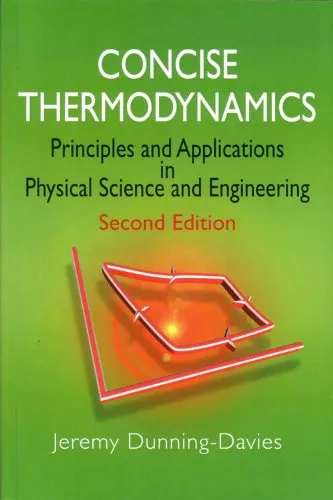
Jeremy Dunning-Davies
Vera, Juan H.;Wilczek-Vera, Grazyna

Juan H. Vera,Grazyna Wilczek-Vera,Claudio Olivera-Fuentes,Costas Panayiotou