

Numerical Solution of Partial Differential Equations in Science and Engineering
Leon Lapidus,George F. Pinder
1999
View book
Book guide and evaluation
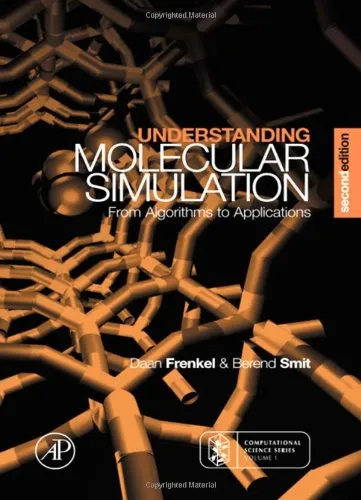
Daan Frenkel,Berend Smit
0 reviews
Published
pages
views
Welcome to the comprehensive introduction to "Understanding Molecular Simulation, Second Edition: From Algorithms to Applications"—a landmark work in the field of computational science. Authored by Daan Frenkel and Berend Smit, this book is a crucial addition for anyo
Before you read
Welcome to the comprehensive introduction to "Understanding Molecular Simulation, Second Edition: From Algorithms to Applications"—a landmark work in the field of computational science. Authored by Daan Frenkel and Berend Smit, this book is a crucial addition for anyone serious about mastering molecular simulations. It provides an in-depth exploration of theoretical principles, algorithms, and a wide array of applications bringing these simulations to life.
"Understanding Molecular Simulation" serves as both a textbook and reference guide for scientists, engineers, and students engaged in molecular simulation studies. Since its first edition, this book has transformed from an instructional manual to a definitive guide that covers fundamental and advanced aspects of the discipline. The second edition builds upon the foundations laid by its predecessor, featuring updated content and reflecting new technological advancements and methodological innovations in the area of molecular simulation.
The book begins with an overview of the basic concepts in statistical thermodynamics, presenting the core principles upon which molecular simulations are built. Readers are then introduced to molecular dynamics (MD) and Monte Carlo (MC) methods—two cornerstone techniques in molecular simulation. The detailed explanations of algorithms are complemented by real-world applications and examples, making the theoretical concepts more accessible.
More advanced topics include free energy calculations, rare event sampling, and the simulation of complex systems. Each chapter is carefully structured, with clear definitions, step-by-step demonstrations, and exercises that reinforce learning. In addition, this book acknowledges the ongoing improvements in computational power and software capabilities, offering insights on how these changes affect simulation strategies.
"In molecular simulation, the most important thing is not the speed of the computer, but the wisdom and experience of the person using it."
"Understanding the nuances of simulation algorithms is crucial to predict the special nature of complex systems accurately."
"Our understanding of molecular systems has reached a stage where simulations can offer insights that experiments alone cannot."
In the ever-evolving field of molecular simulations, possessing a solid grasp of underlying algorithms and their applications is non-negotiable for success. This book, now in its second edition, remains relevant and essential as it continuous to guide readers through both the foundations and cutting edges of the field. Whether you are a graduate student stepping into the world of simulations or a seasoned researcher looking for a detailed reference, this book provides the insights needed for harnessing the full potential of molecular simulations tools.
By bridging theoretical foundations with practical applications, "Understanding Molecular Simulation" serves as a critical resource. Its detailed yet comprehensible approach empowers readers to contribute meaningfully to scientific discoveries and technological advancements in various domains, including chemistry, physics, biology, and materials science.
Your question is answered in the context of this title and author. Each answer uses 2 points.
0 reviews, 4.7 average out of 5
Sign in to publish a review.
Ask a focused question and learn from the community.
Related references that continue this learning path.
Leon Lapidus,George F. Pinder
M Rahman,C. A. (editors) Brebbia
Wil Schilders (auth.),Wilhelmus H. A. Schilders,Henk A. van der Vorst,Joost Rommes (eds.)
Juan H. Vera,Grazyna Wilczek-Vera,Claudio Olivera-Fuentes,Costas Panayiotou