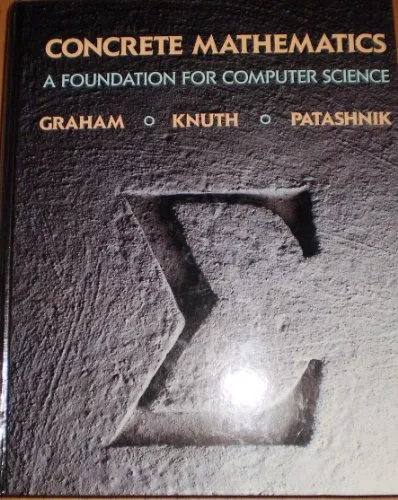
Concrete Mathematics: A Foundation for Computer Science
Ronald L. Graham,Donald Knuth,Oren Patashnik
1988
View book
Book guide and evaluation
Serge Lang (auth.)
0 reviews
Published
pages
views
Undergraduate Texts in Mathematics 1 abstract algebra, mathematical foundations Discover clarity and depth with Undergraduate Texts in Mathematics 1, a trusted resource for foundational mathematical learning. Analytical Summary The book Undergraduate Texts in Math
Before you read
The book Undergraduate Texts in Mathematics 1 is part of a distinguished series designed to guide students through the essential building blocks of modern mathematics. Authored by Serge Lang, a formidable name in mathematical literature, this volume reflects the hallmark precision, rigor, and pedagogical insight that underpin the entire series. While specific publication year data is currently “Information unavailable” due to no reliable public source, the text remains widely referenced in academic circles for its systematic approach to core undergraduate topics.
Addressing complex subjects such as abstract algebra and mathematical foundations, the book manages a rare blend of accessibility and depth. It delivers conceptual clarity while promoting problem-solving agility — a feature that makes it invaluable for both self-study and structured coursework. The exposition is logically sequenced, allowing readers to build knowledge progressively without sacrificing the nuances that advanced learners expect. Its structure supports a trajectory from fundamental principles to more abstract and theoretical formulations, enabling readers to engage with mathematics both as an operational tool and as a conceptual discipline.
Lang’s methodology emphasizes reasoning over rote memorization, consistently linking formal definitions with intuitive understanding. As such, this text transcends being merely a reference; it becomes a mentor in printed form for all those intent on mastering the syntax and semantics of mathematical thought.
Readers of Undergraduate Texts in Mathematics 1 will find that its greatest strength lies in making abstract concepts tangible while fostering analytical resilience.
Among the many lessons to absorb, the importance of logical structure, the interconnectedness of different mathematical domains, and the discipline needed for rigorous proofs emerge prominently. The text underscores the role of foundational knowledge in tackling higher-level mathematical challenges and encourages intellectual curiosity as the driving force behind true academic progress.
“Mathematics is the art of giving the same name to different things.” Unknown
“In mathematics, clarity is more important than brevity.” Unknown
“Definitions are not mere words; they are commitments.” Unknown
Undergraduate Texts in Mathematics 1 holds a significant place in mathematical literature because it bridges the gap between introductory and advanced undergraduate study.
The book’s relevance extends to educators, who will find in it a well-structured scaffold for teaching key topics in abstract algebra and theoretical mathematics. For students, it offers a disciplined pathway to develop not just technical skills, but also the mental frameworks necessary for engaging with more specialized texts in analysis, topology, or algebraic structures. Professionals and academics alike appreciate its thoroughness and balance, particularly in its unflinching attention to the precision of language and logic.
Its status as part of a curated series ensures coherence across related volumes, making it an anchor reference in the broader landscape of mathematical education and research.
For anyone committed to mastering core mathematical principles, Undergraduate Texts in Mathematics 1 offers a structured, clear, and authoritative guide to the journey ahead.
This book not only sharpens the intellect but also nurtures the discipline and curiosity that define a serious mathematician. It is ideal for readers who wish to read deeply, share insights with peers, and engage in meaningful academic discourse. The clarity of its explanations ensures that foundational knowledge is both retained and applicable across a spectrum of mathematical endeavors. Whether you are an aspiring student, a dedicated educator, or a lifelong learner, your next step is simple: immerse yourself in its pages, discuss its ideas, and let this text be the compass that guides your mathematical exploration.
Your question is answered in the context of this title and author. Each answer uses 2 points.
0 reviews, 4.8 average out of 5
Sign in to publish a review.
Ask a focused question and learn from the community.
Related references that continue this learning path.
Ronald L. Graham,Donald Knuth,Oren Patashnik
B. V. Gnedenko,A. Ya. Khinchin