

A Life on Our Planet: My Witness Statement and a Vision for the Future
Sir David Attenborough
2020
View book
Book guide and evaluation
Elizabeth Kolbert
0 reviews
Published
pages
views
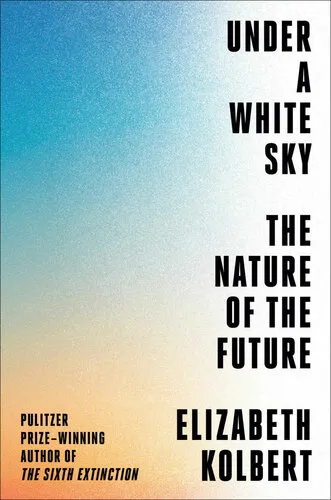
Detailed Summary of the Book In "Under a White Sky: The Nature of the Future," Elizabeth Kolbert explores the paradox of humans' intervention with nature, investigating whether humanity's solutions to ecological damage signify progress or peril. This rigorous exploration
Before you read
In "Under a White Sky: The Nature of the Future," Elizabeth Kolbert explores the paradox of humans' intervention with nature, investigating whether humanity's solutions to ecological damage signify progress or peril. This rigorous exploration is a series of case studies highlighting our ongoing struggle to combat environmental issues while simultaneously deepening our dependency on technological interventions.
Kolbert embarks on a compelling journey through diverse ecosystems, demonstrating our struggle to assert control over nature. She starts by examining the Asian carp's invasion of the Great Lakes, a disaster that led to massive ecological efforts to curtail the spread of this invasive species. This struggle epitomizes the broader trend of confronting biosphere changes with dramatic, sometimes dangerous interventions.
The narrative then delves into the heart of Louisiana, exploring the deliberate engineering of Mississippi River's flow. This feat of human ingenuity is a double-edged sword, showcasing our ability to modify natural landscapes while also revealing the consequences of such manipulations. Kolbert adeptly highlights the delicate balance between restoration and further disruption.
The book's title alludes to the concept of geoengineering, specifically the idea of artificially brightening the sky to counteract global warming. This controversial approach encapsulates the quandaries presented throughout "Under a White Sky," questioning whether we can undo the damage we’ve inflicted on the planet without inflicting further harm.
"We are the interveners, by necessity if not by choice. Our plans have plans, and those plans often go awry."
"The question is not whether we are going to alter the planet, but to what extent."
"Under a White Sky" is more than just an examination of environmental science; it's a profound investigation into humanity's relentless need to both conquer and restore the natural world. With climate change accelerating and its effects becoming more devastating, Kolbert’s book arrives at a critical juncture, prompting reflection on the efficacy and morality of technological solutions to ecological issues.
This book matters because it brings to light the complex dynamics between human ingenuity and nature's resilience. Kolbert’s sharp insights are vital for policymakers, scientists, and general readers, arming them with crucial knowledge about the potential paths and pitfalls in environmental stewardship. Her work urges a reconsideration of how far we should go in our attempts to 'repair' the world we've irrevocably altered.
Ultimately, "Under a White Sky" is a clarion call for greater awareness and a more sustainable interaction with the environment, challenging us to weigh our footprint on this planet more conscientiously.
Your question is answered in the context of this title and author. Each answer uses 2 points.
0 reviews, 4.5 average out of 5
Sign in to publish a review.
Ask a focused question and learn from the community.
Related references that continue this learning path.
Sir David Attenborough


Antonie Jetter,Jeroen Kraaijenbrink,Hans-Horst Schröder,Fons Wijnhoven