
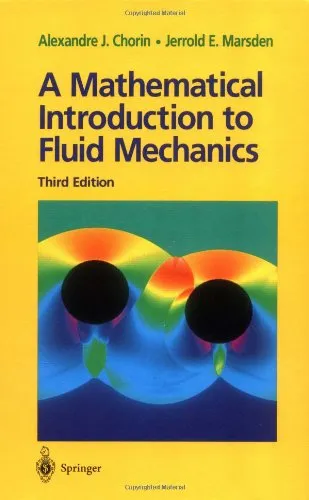
A mathematical introduction to fluid mechanics
Alexandre J. Chorin,Jerrold E. Marsden
1993
View book

Book guide and evaluation
B. E. Launder (auth.),Franz Durst,Nobuhide Kasagi,Brian E. Launder,Frank W. Schmidt,Kenjiro Suzuki,James H. Whitelaw (eds.)
0 reviews
Published
pages
views
Introduction to Turbulent Shear Flows 9: Selected Papers from the Ninth International Symposium on Turbulent Shear Flows, Kyoto, Japan, August 16–18, 1993 The study of turbulent shear flows is one of the most formidable and fascinating areas in the field of fluid dynam
Before you read
The study of turbulent shear flows is one of the most formidable and fascinating areas in the field of fluid dynamics. This book, Turbulent Shear Flows 9, is a curated anthology of cutting-edge research papers presented during the Ninth International Symposium on Turbulent Shear Flows, held in Kyoto, Japan. As turbulence remains a challenging yet critical topic across various scientific and engineering disciplines, this publication serves as a vital resource for academics, researchers, and practitioners aiming to delve into the complexities of turbulent phenomena.
Turbulent shear flows occur in numerous natural and industrial applications, ranging from atmospheric air flow and oceanic currents to flows inside combustion engines, turbines, and chemical processing plants. In Turbulent Shear Flows 9, the collected papers provide a comprehensive examination of the latest developments in fundamental theories, experimental methodologies, and numerical simulations related to turbulent flows. These contributions reflect the significant strides made in turbulence research and highlight emerging techniques addressing long-standing challenges.
The symposium's primary focus was on the refinement of turbulence modeling, the development of improved experimental tools, and leveraging computational fluid mechanics for predictive modeling. Several papers delve into Reynolds-averaged Navier-Stokes (RANS) equations, Large Eddy Simulation (LES), and Direct Numerical Simulation (DNS) as approaches to turbulence studies. You will also find research addressing multi-phase flows, heat transfer in turbulent flows, and near-wall turbulence phenomena that continue to push the boundaries of fluid mechanics.
Moreover, the sessions covered the parametrization of turbulence for applications in aerodynamics, environmental engineering, and energy industries. The authors of these papers discuss both their successes and the remaining limitations, providing invaluable insights into modern-day turbulence research.
"Turbulence, though seemingly chaotic, is governed by fundamental equations that offer limitless opportunities for understanding if studied through creative, systematic approaches."
"The interplay of theory, experimentation, and computation is not merely complementary but essential for the advancement of turbulence research."
This book is an essential read for anyone invested in the field of fluid mechanics and turbulence research. Addressing both fundamental and applied aspects, the compiled papers make it a cornerstone of knowledge for researchers and engineers alike. Its content reflects not just progress but also sets directions for future exploration in turbulence modeling and simulation. Whether you're developing energy-efficient systems or seeking to comprehend atmospheric dynamics, the insights offered in Turbulent Shear Flows 9 are timeless and universally applicable.
The book also emphasizes interdisciplinary collaboration, highlighting the need for joint expertise from mathematicians, physicists, engineers, and computational scientists to overcome the inherent complexities in turbulence. Its honest evaluation of successes and obstacles showcases the evolving nature of this domain, inspiring readers to push the frontier of turbulence studies further. For students and practitioners of fluid dynamics, this compilation is not merely a resource—it's a call to innovate, discover, and understand one of the most intricate phenomena in the physical world.
Your question is answered in the context of this title and author. Each answer uses 2 points.
0 reviews, 4.5 average out of 5
Sign in to publish a review.
Ask a focused question and learn from the community.
Related references that continue this learning path.
Alexandre J. Chorin,Jerrold E. Marsden
Franz Durst,Rainer Friedrich,Brian E. Launder,Frank W. Schmidt,Ulrich Schumann,James H. Whitelaw

Andrey V. Boiko,Alexander V. Dovgal,Genrih R. Grek,Victor V. Kozlov (auth.)
J. C. R. Hunt (auth.),J. P. Bonnet,M. N. Glauser (eds.)