

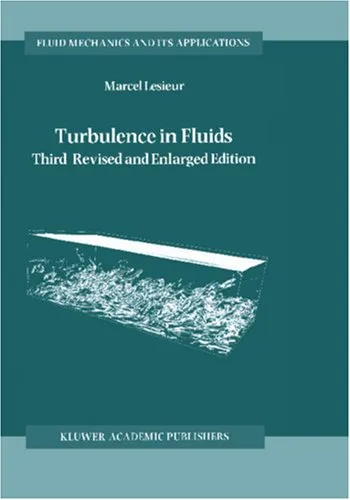
Book guide and evaluation
Turbulence in Fluids, Third (Fluid Mechanics and Its Applications)
M. Lesieur
English
Beginner
Topology
4.2 / 5
0 reviews
1997
Published
288
pages
347
views
Turbulence in Fluids is an attempt to reconcile the theory of turbulence, too often presented in a formal, isolated mathematical context, with the general theory of fluid dynamics. It reviews, in a unifying manner, the main characteristics and general theorems of rotational f
Before you read
What will you get from this book?
Turbulence in Fluids is an attempt to reconcile the theory of turbulence, too often presented in a formal, isolated mathematical context, with the general theory of fluid dynamics. It reviews, in a unifying manner, the main characteristics and general theorems of rotational fluids (liquids or gases), with applications to aerodynamics and geophysical fluid dynamics. Emphasis is placed both on unpredictability, mixing, and coherent vortices or structures. Transition to turbulence in wall or free-shear flows is considered both on the basis of linear-instability theory and of experiments or numerical simulations. Thermal convection is also studied. This third edition presents in a synthetic manner coherent vortices existing both in free or wall-bounded shear flows and in isotropic turbulence. A new mechanics of elementary vortices is built, involving spirals, dipoles, pairings, dislocations, longitudinal hairpins, streaks... It is seen how turbulence topology reacts to the action of stable stratification, rotation, separation or compressibility. The book discusses the phenomenological theories of isotropic turbulence and turbulent diffusion, both in Fourier and physical spaces. It emphasizes the use of two-point closures and stochastic models, a powerful tool allowing representation of strongly nonlinear actions. The role of helicity is considered. A theory of spectral eddy viscosity and backscatter is proposed. The latter phenomenon is shown to govern inverse cascades of passive scalars and small-scale uncertainty. The Renormalization-Group techniques are assessed. The concept of two-dimensional turbulence is looked at, as the simplest approximation of large-scale atmosphere and ocean dynamics. The latter is also studied using geostrophic-turbulence theory. New ideas on cyclogenesis in thermal fronts are presented. Numerous experimental, environmental and aerodynamic examples are provided. A systematic recourse is made to direct and large-eddy-numerical simulations (LES) as a tool for exploring turbulence media. A complete account of the latest dynamic and selective LES techniques is given in this edition. This monograph is a unique tool for graduate students and researchers in mechanical and aerospace engineering, applied mathematics, physics, meteorology, oceanography and astrophysics. It views the problem of turbulence in a very general way: statistical theories, intermittency, transition, coherent structures, singularities, unpredictability or deterministic chaos are only small pieces of the same puzzle, which have to be assembled.
Ask this book
Your question is answered in the context of this title and author. Each answer uses 2 points.
Sign in to ask the book assistant.
Reader reviews
0 reviews, 4.2 average out of 5
No reviews yet
If you have read this book, help the next reader with your experience.
Write a review
Sign in to publish a review.
Reader questions and answers
Ask a focused question and learn from the community.
Sign in to ask or answer a question.
No questions yet
Be the first to ask a clear, useful question.
What to read next
Related references that continue this learning path.



Modern Computer Vision with PyTorch: A Practical Roadmap From Deep Learning Fundamentals to Advanced Applications and Generative AI, 2nd Edition
V Kishore Ayyadevara,Yeshwanth Reddy
2023
View book