

Book guide and evaluation
Topological Methods in Data Analysis and Visualization V: Theory, Algorithms, and Applications
Hamish Carr,Issei Fujishiro,Filip Sadlo,Shigeo Takahashi
English
Beginner
Mathematics
5.0 / 5
0 reviews
2020
Published
264
pages
248
views
Introduction to "Topological Methods in Data Analysis and Visualization V" The fifth installment of the renowned series, "Topological Methods in Data Analysis and Visualization V: Theory, Algorithms, and Applications", delves deeper into the increasingly impactful
Before you read
What will you get from this book?
Introduction to "Topological Methods in Data Analysis and Visualization V"
The fifth installment of the renowned series, "Topological Methods in Data Analysis and Visualization V: Theory, Algorithms, and Applications", delves deeper into the increasingly impactful role of computational topology in data exploration and scientific visualization. This book caters both to seasoned researchers and those new to the field, providing cutting-edge theoretical insights, innovative algorithmic advancements, and practical applications derived from real-world scientific problems. Emerging from the intertwining domains of mathematics, computer science, and data analytics, this volume continues the tradition of demonstrating how topological methods can unlock new perspectives in the analysis and visualization of complex and high-dimensional data.
As data grows more complex, traditional analytical tools often fall short in extracting meaningful insights. The topological approaches presented in this book offer a robust framework for addressing this challenge. The authors explore multi-dimensional data, extreme-scale simulation outputs, and uncertain information, emphasizing their inherent structure and geometry. By bridging theory and application, the book brings forward new methodologies and tools designed for real-world challenges in areas like medicine, engineering, physics, and beyond.
This volume serves as a valuable resource for students, researchers, and professionals interested in computational topology, data-driven discovery, and advanced visualization techniques. By investigating these topics, the readers will find themselves equipped with novel approaches that redefine how they understand and interpret contemporary data.
Detailed Summary of the Book
"Topological Methods in Data Analysis and Visualization V" is divided into three primary thematic sections: theory, algorithms, and applications.
- Theory: The book explores foundational concepts in topological data analysis (TDA), including persistent homology, Reeb graphs, Morse theory, and combinatorial topology. These subjects are presented with mathematical rigor, showcasing the underlying principles that make topology such a powerful tool for understanding data structure and connectedness.
- Algorithms: A significant portion of the book focuses on innovative algorithms that leverage topology to process and visualize data. These include efficient techniques for computing persistence diagrams, optimizing simplicial complexes, multiscale analysis methods, and performance-focused implementations compatible with modern computing architectures.
- Applications: The final section brings the theoretical and algorithmic concepts to life with real-world case studies. From analyzing climate science data to uncovering patterns in medical imaging or even exploring astrophysical simulations, the applications demonstrate the practical relevance and utility of topological methods in diverse scientific disciplines.
The seamless combination of these three elements ensures that readers not only understand the mathematical and computational underpinnings of TDA but also appreciate its transformative potential in addressing real-world data complexity.
Key Takeaways
- A deep understanding of topological methods, including their mathematical foundations and computational implementations.
- Insight into cutting-edge algorithms designed for topology-based data analysis and visualization.
- Practical applications of TDA across diverse fields such as medicine, engineering, and climate science.
- Strategies for overcoming challenges in high-dimensional and complex data analysis.
- A robust framework for interpreting data from a structural and geometrical perspective.
Famous Quotes from the Book
"Topology provides a lens through which we can discern structure in data where traditional methods may falter."
"In the complexity of multi-dimensional data lies a beauty, waiting to be unveiled by topological analysis."
Why This Book Matters
The field of data science is rapidly evolving, with datasets becoming more intricate in size and structure. Conventional analytical tools often struggle to accommodate the growing complexity of modern data, leading researchers to seek innovative methodologies capable of capturing the subtleties in high dimensions.
This book matters because it tackles these challenges with the elegance and precision of topology, merging mathematical theory and practical tools. By making complex structures comprehensible and preserving critical features of the data, topological methods enable researchers to extract deeper insights, often with computational efficiency.
Furthermore, this volume doesn't confine itself to theory or niche applications. It provides balanced coverage of practical implementations, bridging the gap between research and practice. These insights resonate particularly well in today's landscape, where data-driven decision-making underpins success across virtually all domains.
For researchers, practitioners, or students delving into data analytics, computational mathematics, or visualization, "Topological Methods in Data Analysis and Visualization V" is more than a book—it's a gateway into the future of data interpretation. Its emphasis on innovation and interdisciplinary collaboration ensures its relevance for years to come.
Ask this book
Your question is answered in the context of this title and author. Each answer uses 2 points.
Sign in to ask the book assistant.
Reader reviews
0 reviews, 5.0 average out of 5
No reviews yet
If you have read this book, help the next reader with your experience.
Write a review
Sign in to publish a review.
Reader questions and answers
Ask a focused question and learn from the community.
Sign in to ask or answer a question.
No questions yet
Be the first to ask a clear, useful question.
What to read next
Related references that continue this learning path.

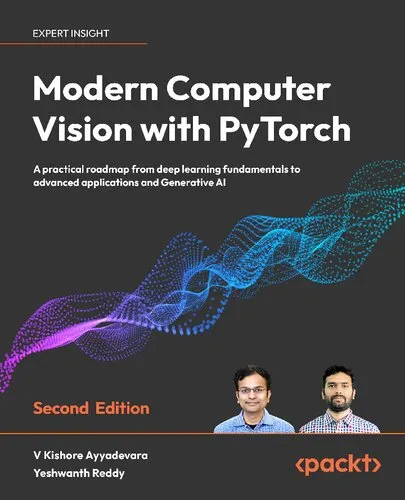
Modern Computer Vision with PyTorch: A Practical Roadmap From Deep Learning Fundamentals to Advanced Applications and Generative AI, 2nd Edition
V Kishore Ayyadevara,Yeshwanth Reddy
2023
View book