

Book guide and evaluation
Topological Methods in Data Analysis and Visualization IV: Theory, Algorithms, and Applications
Hamish Carr,Christoph Garth,Tino Weinkauf (eds.)
English
Beginner
Mathematics
5.0 / 5
0 reviews
2017
Published
355
pages
184
views
Welcome to Topological Methods in Data Analysis and Visualization IV: Theory, Algorithms, and Applications. This book represents a critical resource for those engaged in data science, computational topology, and visualization, offering significant insights into the th
Before you read
What will you get from this book?
Welcome to Topological Methods in Data Analysis and Visualization IV: Theory, Algorithms, and Applications. This book represents a critical resource for those engaged in data science, computational topology, and visualization, offering significant insights into the theoretical foundations, algorithmic developments, and practical applications of topological techniques for analyzing complex datasets. Curated and crafted by experts Hamish Carr, Christoph Garth, and Tino Weinkauf, this volume serves as the fourth iteration in a celebrated series that explores the intersection of topology and data analysis with growing relevance in today’s data-driven world.
Detailed Summary of the Book
This book delves into advanced methodologies and frameworks emerging from the field of topological data analysis (TDA) and data visualization. With the exponential growth of datasets across various domains such as climate science, biology, engineering, and social networks, traditional techniques often fall short in uncovering inherent structures and relationships. Here is where topology—the mathematical study of shape, space, and continuity—bridges the gap. In this volume, the authors and contributors illuminate the relevance of topological methods in handling large, dynamic, and often noisy datasets.
The book is divided into three key areas: algorithm design, theoretical advancements, and practical applications. Chapters are contributed by leading researchers, ensuring that readers gain access to cutting-edge advancements. Topics such as persistence diagrams, Morse theory, Reeb graphs, and discrete Morse complexes are explored in depth, alongside their relevance to real-world problems like fluid dynamics, structural biology, and image analysis. Special focus is placed on multidimensional data, creating pathways for numerical techniques to efficiently analyze higher-dimensional phenomena. Moreover, interactive visualization techniques are discussed, highlighting tools that allow scientists to intuitively interpret outcomes of topological analysis.
Key Takeaways
- Topological Foundations: The book introduces readers to critical topological concepts such as Betti numbers, persistence, and simplicial complexes, bridging the gap between theory and usability.
- Algorithmic Frameworks: Learn about state-of-the-art algorithms that make topological methods both computationally feasible and scalable across diverse datasets.
- Applications in Diverse Domains: From fluid simulations in engineering to studying neuronal networks in biology, you’ll witness how topological paradigms outperform traditional data analysis approaches.
- Visualization at its Core: The book emphasizes interactive and immersive tools that combine topology with modern visualization technologies, fostering intuitive data exploration.
- The Future of TDA: Gain unique perspectives on emerging avenues in TDA, including its role in machine learning, AI explainability, and handling dynamic systems.
Famous Quotes from the Book
"Topology offers a lens through which the structure and behavior of data can be distilled, understood, and leveraged with unparalleled clarity."
"The interplay between computation and topology creates a fertile ground for novel insights that would otherwise remain hidden."
"Visualization is not just about seeing but understanding—and topological methods are at the heart of this quest."
Why This Book Matters
In an era dominated by big data, the demand for insights that transcend raw statistics has never been higher. Mathematical topology, once considered an abstract discipline, has emerged as a vital tool for uncovering patterns and relationships in massive datasets. This book matters because it equips both academics and practitioners with the core knowledge and tools to leverage topological techniques effectively. By translating intricate mathematical ideas into actionable solutions for real-world problems, the authors and collaborators have created a guide that is both comprehensive and accessible.
Additionally, as datasets grow increasingly multidimensional and heterogeneous, traditional methods frequently struggle to scale, while topological methods naturally adapt to such complexities. Whether you are developing algorithms or assessing model behavior, this book will act as a cornerstone for your research or industrial endeavors. Its emphasis on the synergy between theory, computation, and visualization fills a critical void in the literature, paving the way for future breakthroughs in data science and beyond.
In conclusion, Topological Methods in Data Analysis and Visualization IV serves as both a reference and an inspiration for those aiming to push the boundaries of what is possible in data analysis and visualization. It demonstrates the power of combining mathematical rigor with practical applications, leaving readers equipped and inspired to tackle the challenges of tomorrow’s data complexities.
Ask this book
Your question is answered in the context of this title and author. Each answer uses 2 points.
Sign in to ask the book assistant.
Reader reviews
0 reviews, 5.0 average out of 5
No reviews yet
If you have read this book, help the next reader with your experience.
Write a review
Sign in to publish a review.
Reader questions and answers
Ask a focused question and learn from the community.
Sign in to ask or answer a question.
No questions yet
Be the first to ask a clear, useful question.
What to read next
Related references that continue this learning path.

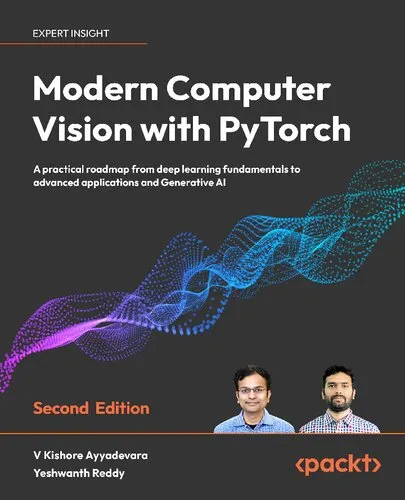
Modern Computer Vision with PyTorch: A Practical Roadmap From Deep Learning Fundamentals to Advanced Applications and Generative AI, 2nd Edition
V Kishore Ayyadevara,Yeshwanth Reddy
2023
View book