

Book guide and evaluation
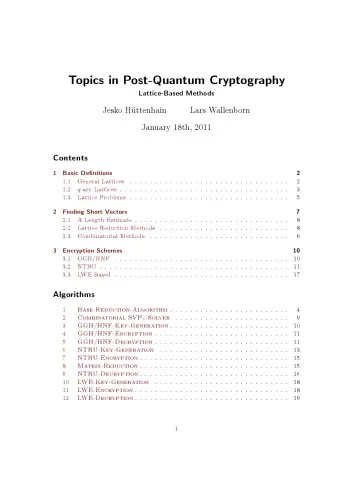
Topics in Post-Quantum Cryptography: Lattice-Based Methods
Jesko Hüttenhain,Lars Wallenborn
English
Beginner
Mathematics
4.9 / 5
0 reviews
2011
Published
23
pages
285
views
Introduction to "Topics in Post-Quantum Cryptography: Lattice-Based Methods" Cryptography has long been a cornerstone of secure communication and data privacy in the digital age. However, a seismic shift in the computational land
Before you read
What will you get from this book?
Introduction to "Topics in Post-Quantum Cryptography: Lattice-Based Methods"
Cryptography has long been a cornerstone of secure communication and data privacy in the digital age. However, a seismic shift in the computational landscape is rapidly approaching: the advent of practical quantum computing. The emergence of quantum technology poses significant threats to the cryptographic protocols we currently rely on, potentially rendering classical methods useless in the face of highly efficient quantum algorithms like Shor’s algorithm. "Topics in Post-Quantum Cryptography: Lattice-Based Methods" is a comprehensive guide to one of the most promising branches of post-quantum cryptographic (PQC) solutions: lattice-based cryptography. Written for researchers, academics, and industry practitioners alike, this book delves deeply into the theoretical underpinnings and practical applications of lattice-based systems as a secure alternative in the age of quantum computing.
Detailed Summary of the Book
The book is structured to provide readers with a gradual yet comprehensive understanding of lattice-based cryptographic methods, starting from foundational mathematics to advanced protocols and real-world applications. Early chapters focus on introducing lattice theory, providing an accessible entry point for readers unfamiliar with the subject. Concepts like lattice structures, basis reduction, and shortest vector problems (SVPs) are thoroughly explained alongside their computational hardness, forming the backbone of secure post-quantum schemes.
Subsequent chapters discuss key cryptographic constructions enabled by lattices, such as encryption schemes, digital signatures, and homomorphic encryption. Real-world security analyses and performance trade-offs are explored in depth, empowering readers to understand why lattice problems are ideally suited for post-quantum security. Furthermore, implementations, optimizations, and challenges in deploying lattice-based methods in practical systems are covered to bridge the gap between theory and practice.
The latter sections of the book focus on advanced topics, including multifaceted cryptographic protocols like zero-knowledge proofs, commitment schemes, and advanced lattice-based constructions such as learning with errors (LWE) and learning with rounding (LWR). The text concludes with a discussion of emerging trends, highlighting ongoing research and unresolved challenges faced by the cryptographic community in this fast-evolving field.
Key Takeaways
- Lattices form a highly versatile mathematical foundation for cryptography, with their computational hardness being resistant to both classical and quantum attacks.
- Lattice-based cryptography enables efficient implementations of encryption schemes, digital signatures, and advanced techniques like fully homomorphic encryption.
- The book explores the Learning With Errors (LWE) and Learning With Rounding (LWR) problems in-depth, which are pivotal to the security of modern lattice-based protocols.
- Practical implementation challenges such as key size, computational efficiency, and parameter selection are thoroughly discussed to aid researchers and implementers.
- Lattice-based methods support exciting new cryptographic notions such as quantum-safe secure multi-party computation, zero-knowledge proofs, and privacy-preserving systems.
Famous Quotes from the Book
"The impending quantum revolution requires a radical shift in our approach to cryptographic security. Among the leading contenders, lattice-based cryptography stands as one of the strongest bastions of a post-quantum world."
"Security must be engineered on assumptions that remain safe under both classical and quantum computation. This is the essence of lattice-based cryptographic design."
Why This Book Matters
As quantum computing edges closer to maturity, the cryptographic infrastructure safeguarding modern technologies faces an unprecedented challenge. Many widely used cryptographic systems, such as RSA and ECC (Elliptic Curve Cryptography), are vulnerable to quantum attacks. Lattice-based cryptography has emerged as a leading solution for post-quantum security, offering a compelling balance between theoretical robustness and practical feasibility.
"Topics in Post-Quantum Cryptography: Lattice-Based Methods" equips readers with the knowledge necessary to understand, analyze, and implement post-quantum cryptographic solutions grounded in lattice theory. By focusing on one of the most versatile and researched approaches, this book ensures readers are at the forefront of cryptographic advancements, preparing them to meet the demands of a quantum-secure future.
Beyond its academic value, the book inspires collaboration across disciplines, encouraging mathematicians, computer scientists, and engineers to contribute to the collective effort of building next-generation cryptographic tools. If secure and efficient communication technologies are to thrive in the quantum era, resources like this book will prove instrumental.
Ask this book
Your question is answered in the context of this title and author. Each answer uses 2 points.
Sign in to ask the book assistant.
Reader reviews
0 reviews, 4.9 average out of 5
No reviews yet
If you have read this book, help the next reader with your experience.
Write a review
Sign in to publish a review.
Reader questions and answers
Ask a focused question and learn from the community.
Sign in to ask or answer a question.
No questions yet
Be the first to ask a clear, useful question.
What to read next
Related references that continue this learning path.

Modern Computer Vision with PyTorch: A Practical Roadmap From Deep Learning Fundamentals to Advanced Applications and Generative AI, 2nd Edition
V Kishore Ayyadevara,Yeshwanth Reddy
2023
View book