
Computational commutative and non-commutative algebraic geometry
Svetlana Cojocaru,Svetlana Cojocaru,Gerhard Pfister,Victor Ufnarovski
2005
View book
Book guide and evaluation
Arnaldo Garcia (editor),Henning Stichtenoth (editor)
0 reviews
Published
pages
views
Introduction to 'Topics in Geometry, Coding Theory and Cryptography' Welcome to an enriching exploration of the interrelated domains of geometry, coding theory, and cryptography, encapsulated in the book 'Topics in Geometry, Coding Theory and Cryptography'. Edited by renow
Before you read
Welcome to an enriching exploration of the interrelated domains of geometry, coding theory, and cryptography, encapsulated in the book 'Topics in Geometry, Coding Theory and Cryptography'. Edited by renowned mathematicians Arnaldo Garcia and Henning Stichtenoth, this volume presents a curated collection of significant contributions in these fields, woven together by a common theme of algebraic frameworks.
The book serves as a compendium of advanced topics at the intersection of geometry, coding theory, and cryptography. It is composed of several chapters contributed by experts, each delving into specific themes that illustrate the profound connections and applications within these areas. The book is part of the "Algebra and Applications" series and meticulously bridges theoretical concepts with practical applications.
In the realm of geometry, the book emphasizes algebraic geometry and its implications in coding theory and cryptography. It explores the fundamental structures and properties essential for understanding geometric codes. The coding theory section details constructions and analyses of error-correcting codes, a pivotal component in data transmission efficiency and accuracy. Furthermore, the complexity of cryptographic systems is dissected, offering insights into organizing secure and private communication channels over potentially adversarial networks.
"Mathematics is the art of giving the same name to different things. The symbiosis between coding theory, cryptography, and geometry exemplifies this art with elegance and complexity."
"In a world of increasing digital communication, the strength of our codes defines the resilience of our privacy."
'Topics in Geometry, Coding Theory and Cryptography' stands as a testament to the interdisciplinary nature of modern mathematics. As digital communication infiltrates every corner of our lives, understanding the theoretical foundations that secure and optimize these systems is crucial not only for mathematicians but for engineers and computer scientists alike. The book is of particular value to those involved in research and development in data security and transmission.
Furthermore, it serves as an important educational resource, introducing complex concepts in an accessible manner. The blend of theoretical exposition with practical applications fosters a deeper understanding of how abstract mathematical principles directly impact real-world technologies. It illustrates how robust, secure systems are crafted by intertwining these seemingly disparate fields.
In essence, this book provides the tools necessary to comprehend and further innovate in the vital areas of coding and cryptography, making it an indispensable asset for both budding and seasoned researchers.
Your question is answered in the context of this title and author. Each answer uses 2 points.
0 reviews, 4.5 average out of 5
Sign in to publish a review.
Ask a focused question and learn from the community.
Related references that continue this learning path.
Svetlana Cojocaru,Svetlana Cojocaru,Gerhard Pfister,Victor Ufnarovski
Arnaldo Garcia,Henning Stichtenoth
Benjamin Fine,Delaram Kahrobaei,Gerhard Rosenberger
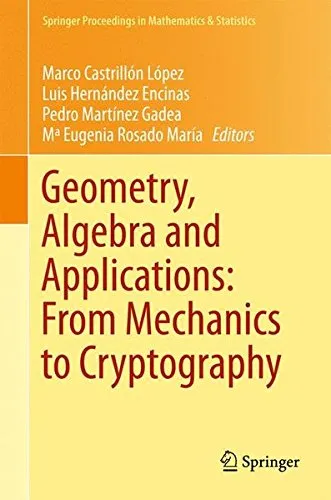
Encinas, Luis Hernández;Gadea, Pedro Martínez;López, Marco Castrillón;María, Mª Eugenia Rosado;Muñoz Masqué, Jaime (eds.)