Book guide and evaluation
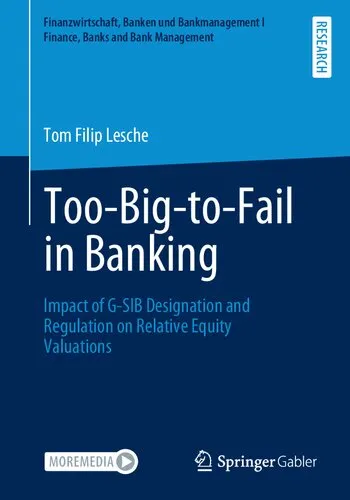
Too-Big-to-Fail in Banking: Impact of G-SIB Designation and Regulation on Relative Equity Valuations
Tom Filip Lesche
English
Beginner
Finance
4.5 / 5
0 reviews
2021
Published
256
pages
696
views
Introduction The global financial system is a complex and interwoven network, and at its heart lies a crucial concept - the "Too-Big-to-Fail" doctrine. This principle gained significant prominence during the financial crisis of 2008, highlighting the associated risks and
Before you read
What will you get from this book?
Introduction
The global financial system is a complex and interwoven network, and at its heart lies a crucial concept - the "Too-Big-to-Fail" doctrine. This principle gained significant prominence during the financial crisis of 2008, highlighting the associated risks and regulatory challenges of large multinational banks. In "Too-Big-to-Fail in Banking: Impact of G-SIB Designation and Regulation on Relative Equity Valuations," we delve into the intricate world of global systemically important banks (G-SIBs), unraveling the impact of regulatory frameworks on their operations and equity valuations. This book provides an in-depth analysis of how G-SIB designations influence the global banking sector and capital markets.
Detailed Summary of the Book
The book meticulously examines the ramifications of the "Too-Big-to-Fail" policy, particularly focusing on the G-SIB designation. G-SIBs are institutions whose failure could trigger a global economic meltdown. The narrative begins with a historical perspective, charting the evolution of banking regulations and their critical role in maintaining financial stability. Through a combination of empirical research, case studies, and theoretical frameworks, this book illustrates the effects of stringent post-crisis regulations on G-SIBs, especially in terms of their market valuation and competitive positioning.
The book also critiques the underlying assumptions of the existing regulatory measures and explores how these interventions shape market perceptions and investor behavior. By analyzing data-driven insights, it provides valuable perspectives on how regulations can be balanced to ensure both economic growth and systemic stability.
Key Takeaways
- Understanding of the historical and contemporary role of "Too-Big-to-Fail" in banking.
- Insights into the regulatory landscape post-2008 financial crisis, including Basel III and Dodd-Frank Act.
- Analysis of the impact of G-SIB designations on market valuations of banking institutions.
- Critical evaluation of regulatory challenges and the effectiveness of current measures in preventing future crises.
- Strategic frameworks for balancing regulatory interventions and market efficiency.
Famous Quotes from the Book
"The label of being 'too-big-to-fail' is a double-edged sword, wielding power over markets and yet shackling institutions with the weight of expectations."
"Regulation, in the pursuit of stability, must not stifle the very agents of growth it seeks to protect."
Why This Book Matters
In the wake of globalization and digital transformation, the banking sector encounters new challenges and opportunities. This book is instrumental for policymakers, banking professionals, and academicians seeking to decode the impacts of stringent regulations on G-SIBs. It shines a light on the delicate balance between securing financial stability and fostering an environment of innovation and growth within the banking industry.
Furthermore, by decoding the intricacies of market valuations influenced by the G-SIB status, the book stands as a vital resource for investors and financial analysts making informed decisions in the evolving landscape of global finance.
Ask this book
Your question is answered in the context of this title and author. Each answer uses 2 points.
Sign in to ask the book assistant.
Reader reviews
0 reviews, 4.5 average out of 5
No reviews yet
If you have read this book, help the next reader with your experience.
Write a review
Sign in to publish a review.
Reader questions and answers
Ask a focused question and learn from the community.
Sign in to ask or answer a question.
No questions yet
Be the first to ask a clear, useful question.
What to read next
Related references that continue this learning path.