Book guide and evaluation
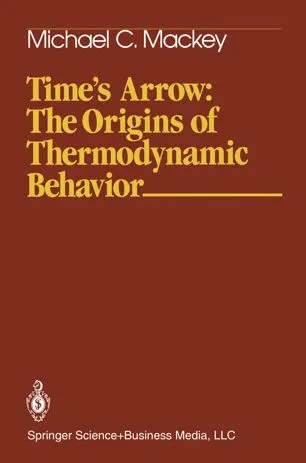
Time’s Arrow: The Origins of Thermodynamic Behavior
Michael C. Mackey
English
Beginner
Physics
4.0 / 5
0 reviews
1992
Published
188
pages
720
views
Welcome to the world of thermodynamics, a field of physics that has intrigued scientists and philosophers alike due to its profound implications on our understanding of the universe. In "Time's Arrow: The Origins of Thermodynamic Behavior," we delve into the fascinati
Before you read
What will you get from this book?
Welcome to the world of thermodynamics, a field of physics that has intrigued scientists and philosophers alike due to its profound implications on our understanding of the universe. In "Time's Arrow: The Origins of Thermodynamic Behavior," we delve into the fascinating journey of thermodynamic concepts, exploring the essence of time and the symmetry-breaking phenomenon that gives time its momentum. This book serves as a comprehensive guide for both novice readers and skilled practitioners of the scientific discipline that unravels the mysteries of energy transformations and the passage of time.
Summary of the Book
"Time’s Arrow: The Origins of Thermodynamic Behavior" provides an in-depth analysis of the asymmetric nature of time and its fundamental relation to thermodynamics. The book takes you through historical insights from early thinkers like Sadi Carnot and Ludwig Boltzmann, whose pioneering work laid the foundation of thermodynamics. Our exploration covers the intricate laws of thermodynamics, such as the conservation of energy and entropy, crucial for understanding natural processes. Through methodical discussions, the book also examines emergent phenomena in systems far from equilibrium and their unexpected order and complexity, bridging physics with philosophical perspectives on the nature of time.
Key Takeaways
- The irreversible nature of time is closely tied to the second law of thermodynamics, which underscores the increasing nature of entropy.
- Understanding thermodynamic principles can offer profound insights into not only scientific but also philosophical inquiries about time and existence.
- Emergent behaviors in non-equilibrium systems exhibit an unanticipated order, challenging traditional thermodynamic theories.
- Historical and contemporary views on thermodynamics fortify the link between microscopic and macroscopic observations, allowing deeper comprehension of time's directionality.
Famous Quotes from the Book
"Entropy is time’s arrow, pointing in a single direction from past to future, from order to disorder."
"The dance of molecules, reflecting chaos and order alike, is orchestrated by the invisible baton of thermodynamics."
"The past, entrenched in low entropy configuration, is a tapestry from which the present and future weave their unpredictable yet inevitable patterns."
Why This Book Matters
This book matters because it tackles one of the most intriguing puzzles in science: why does time seem to move only in one direction? Addressing both scientific and philosophical issues, "Time’s Arrow: The Origins of Thermodynamic Behavior" frames the discourse on how thermodynamics not only shapes the physical universe but also influences our perception of reality. By demystifying complex ideas and providing a solid historical context, the book invites readers to ponder time’s mysterious march and its governing principles. The insights gathered here transcend the domain of physics, inviting interdisciplinary dialogue that enriches both scientific inquiry and broader philosophical contemplation.
Ask this book
Your question is answered in the context of this title and author. Each answer uses 2 points.
Sign in to ask the book assistant.
Reader reviews
0 reviews, 4.0 average out of 5
No reviews yet
If you have read this book, help the next reader with your experience.
Write a review
Sign in to publish a review.
Reader questions and answers
Ask a focused question and learn from the community.
Sign in to ask or answer a question.
No questions yet
Be the first to ask a clear, useful question.
What to read next
Related references that continue this learning path.