
Book guide and evaluation
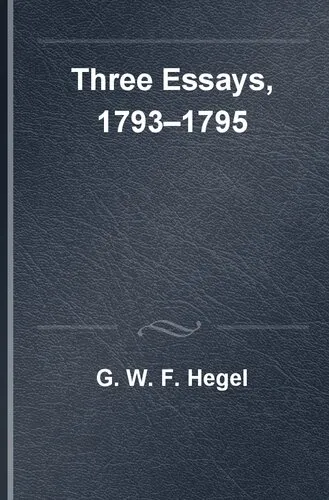
Three Essays, 1793-1795: The Tubingen Essay, Berne Fragments, the Life of Jesus (English and German Edition)
Georg Wilhelm Friedrich Hegel
English
Beginner
Medical
4.3 / 5
0 reviews
1984
Published
183
pages
549
views
Introduction to 'Three Essays, 1793-1795: The Tubingen Essay, Berne Fragments, the Life of Jesus' The collection titled "Three Essays, 1793-1795: The Tubingen Essay, Berne Fragments, The Life of Jesus" provides a deep insight into the nascent philos
Before you read
What will you get from this book?
Introduction to 'Three Essays, 1793-1795: The Tubingen Essay, Berne Fragments, the Life of Jesus'
The collection titled "Three Essays, 1793-1795: The Tubingen Essay, Berne Fragments, The Life of Jesus" provides a deep insight into the nascent philosophical ideas of Georg Wilhelm Friedrich Hegel. Spanning the years between 1793 and 1795, these writings are a glimpse into Hegel's early intellectual struggles and foundations that would later blossom into his renowned philosophical system. This anthology is a blend of essays that highlight Hegel's exploration of religion, philosophy, and history, demonstrating his engagement with the Enlightenment's key ideas.
Detailed Summary of the Book
The book is a tripartite collection of early essays written by Hegel during his time as a student and young thinker. It includes:
- The Tubingen Essay: Written during Hegel's stay at the Tubingen Seminary, this essay reflects on politics and religion during the Enlightenment. Here, Hegel expresses his early insights on how political structures and religious beliefs intersect and influence human progress and morality.
- The Berne Fragments: Penned during his time in Berne, these fragments show Hegel's first glimmers of historical consciousness and critique of religion. They are a collection of aphorisms and short essays where Hegel begins dismantling traditional theological concepts to pave the way for a more human-centered understanding of spirituality.
- The Life of Jesus: This work reveals Hegel's aim to reconstruct the figure of Jesus as a historical individual and a moral teacher, rather than simply the divine being central to Christian dogma. Here, Hegel's humanism shines, emphasizing Jesus' teachings as revolutionary ideas aligned with ethical development rather than strictly religious doctrine.
Key Takeaways
Emergence of Dialectical Thinking: These essays mark the seeds of Hegel's dialectical method, indicative of his later works where reason and contradiction synthesize to form new truths.
Human-Centered Theology: Hegel's early challenge against religious orthodoxy centers on viewing religious figures as progenitors of ethical and moral advancement rather than divine beings.
Critical Historical Perspective: The essays show Hegel's budding interest in historical processes and their impact on human consciousness.
Famous Quotes from the Book
"Enlightenment is man's emergence from his self-imposed immaturity."
"The divine is not beyond us, but within us."
Why This Book Matters
"Three Essays, 1793-1795" is crucial for understanding the embryonic stage of Hegel's philosophical journey. These writings not only forecast his later intellectual triumphs but also underline a critical epoch during the Enlightenment where religion, ethics, and history intersected dramatically. They offer readers a rare glimpse into the mind of a philosopher who would substantially shape modern philosophical discourse.
The book's importance lies in revealing Hegel’s analytical depth even at this early stage, showing his willingness to question established norms and imagine a world where human thought determines the structure of reality. As such, it serves as an invaluable resource for students of philosophy, history, and theology alike.
Ask this book
Your question is answered in the context of this title and author. Each answer uses 2 points.
Sign in to ask the book assistant.
Your previous questions
give me a summary
"Three Essays, 1793-1795: The Tubingen Essay, Berne Fragments, the Life of Jesus" is a collection of early writings by Georg Wilhelm Friedrich Hegel that provide insight into his developing thoughts and philosophical ideas.
1. **The Tubingen Essay**: Written during Hegel's time at the Tübingen Seminary, this essay explores themes of religion and theology. It reflects on the relationship between individual faith and institutional religion, suggesting a move towards a more personal and subjective understanding of spirituality.
2. **The Berne Fragments**: Composed while Hegel was in Bern, these fragments delve into political and social philosophy. They reveal Hegel's early critique of existing social structures and his thoughts on freedom, the state, and the role of individuals within society. The fragments hint at Hegel's developing ideas about the dialectical process and historical change.
3. **The Life of Jesus**: This essay presents a philosophical examination of the life and teachings of Jesus Christ. Hegel analyzes the moral and ethical implications of Jesus' message, emphasizing the importance of understanding Jesus not just as a religious icon, but as a transformative figure whose teachings challenge established religious doctrines.
Together, these essays showcase Hegel's formative philosophical explorations, setting the groundwork for his later, more developed work in German idealism.
Reader reviews
0 reviews, 4.3 average out of 5
No reviews yet
If you have read this book, help the next reader with your experience.
Write a review
Sign in to publish a review.
Reader questions and answers
Ask a focused question and learn from the community.
Sign in to ask or answer a question.
No questions yet
Be the first to ask a clear, useful question.
What to read next
Related references that continue this learning path.
Pocket Companion to Guyton and Hall Textbook of Medical Physiology, 12e
John E. Hall PhD
2011
View book
Williams Obstetrics, 26th Edition
F. Gary Cunningham,Kenneth J. Leveno,Jodi S. Dashe,Barbara L. Hoffman,Catherine Y. Spong,Brian M. Casey
2022
View book