
Book guide and evaluation
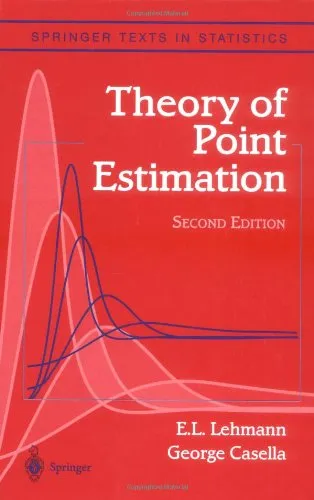
Theory of Point Estimation
E.L. Lehmann,George Casella
English
Beginner
Mathematical Analysis
4.6 / 5
0 reviews
1998
Published
617
pages
948
views
Introduction to 'Theory of Point Estimation' Welcome to the world of statistical theory, where we dive deep into one of the essential domains of statistical inference - point estimation. "Theory of Point Estimation" is an authoritative and comprehensive book authored by th
Before you read
What will you get from this book?
Introduction to 'Theory of Point Estimation'
Welcome to the world of statistical theory, where we dive deep into one of the essential domains of statistical inference - point estimation. "Theory of Point Estimation" is an authoritative and comprehensive book authored by the acclaimed statisticians E.L. Lehmann and George Casella.
Detailed Summary of the Book
The book "Theory of Point Estimation" offers a rigorous exploration of the fundamental principles and advanced techniques in the area of point estimation. Recognized as a cornerstone in statistical theory literature, this text provides an in-depth understanding of the methodologies used for estimating the parameters of probability distributions.
The book covers a wide array of classical and modern estimation theories. It begins with the foundational concepts such as unbiasedness, consistency, and the method of moments. The text progresses to discuss more intricate topics such as maximum likelihood estimators (MLE), Bayesian methods, and minimax estimation. In later chapters, the authors present robust and non-parametric estimation techniques, reflecting the more recent advances in the field.
A distinctive feature of the book is its balance between theoretical foundations and practical implications. The authors meticulously provide proofs to theorems and theorems, ensuring that readers not only comprehend the results but also understand the underlying logic. Furthermore, the book includes numerous examples and exercises that illustrate the application of theoretical principles to real-world problems.
Key Takeaways
This book serves as an essential guide for statisticians, mathematicians, and anyone involved in data analysis or statistical research. Here are some key takeaways that readers can gain:
- Understanding of Core Concepts: Learn about the fundamental criteria such as unbiasedness, efficiency, and sufficiency which are central to point estimation.
- Theoretical Rigor: The book ensures a deep dive into complex proofs and derivations, enhancing comprehension of advanced statistical methods.
- Diverse Estimation Methods: Familiarize yourself with a variety of estimation techniques, including classical and innovative approaches applicable in diverse scenarios.
- Practical Applications: With numerous examples, see how theoretical principles are applied in practical, real-world settings.
Famous Quotes from the Book
"The object of estimation theory is to extract from observations pertinent information about the parameters of interest."
"Much of classical estimation theory deals with unbiased estimators, because mathematically they have many convenient properties."
Why This Book Matters
"Theory of Point Estimation" plays a critical role in the field of statistics, serving as a foundational text for students and professionals alike. Its importance can be attributed to several factors:
First, it provides a comprehensive examination of point estimation theory, a key component of statistical inference. Understanding the various methods of point estimation is crucial for making accurate predictions and inferences from data.
Second, the authors, E.L. Lehmann and George Casella, are revered figures in the statistical community. Their expertise and contributions have greatly influenced modern statistical thought, making this book a credible and authoritative resource.
Lastly, the book's approach, which balances theory and practice, makes it a versatile resource, applicable to a wide range of disciplines that rely on statistical methods. Whether used for academic purposes, research, or in professional industry settings, the insights gleaned from this book empower readers to apply statistical techniques more effectively and accurately.
Ask this book
Your question is answered in the context of this title and author. Each answer uses 2 points.
Sign in to ask the book assistant.
Reader reviews
0 reviews, 4.6 average out of 5
No reviews yet
If you have read this book, help the next reader with your experience.
Write a review
Sign in to publish a review.
Reader questions and answers
Ask a focused question and learn from the community.
Sign in to ask or answer a question.
No questions yet
Be the first to ask a clear, useful question.
What to read next
Related references that continue this learning path.
Functional Equations and Inequalities: Solutions and Stability Results
K Ravi;B V Senthil Kumar;John Michael Rassias
2017
View book