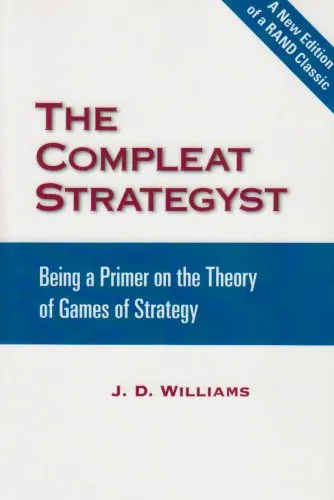
The Compleat Strategyst: Being a Primer on the Theory of Games of Strategy
John D. Williams
2007
View book
Book guide and evaluation
John von Neumann;Oskar Morgenstern;Harold William Kuhn;Ariel Rubinstein
0 reviews
Published
pages
views
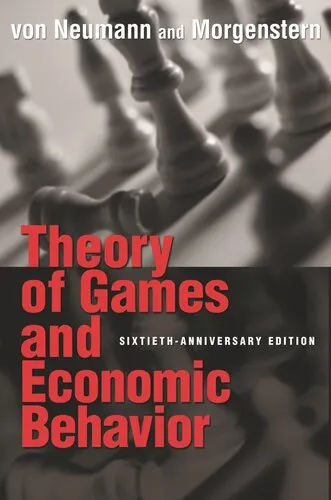
Introduction to "Theory of Games and Economic Behavior: 60th Anniversary Commemorative Edition" First published in 1944, Theory of Games and Economic Behavior by John von Neumann and Oskar Morgenstern revolutionized the fields of economics, mathematics, and social sciences
Before you read
First published in 1944, Theory of Games and Economic Behavior by John von Neumann and Oskar Morgenstern revolutionized the fields of economics, mathematics, and social sciences by introducing game theory as a formal and systematic framework for analyzing strategic interactions. The 60th Anniversary Commemorative Edition preserves the groundbreaking ideas of the original work while reflecting on its enduring legacy. This edition includes Harold William Kuhn’s editorial commentary and Ariel Rubinstein's insights into its historical and intellectual impact. It remains a seminal work that bridges disciplines and continues to shape modern thought.
As the first comprehensive attempt to formalize the theory of strategic games, this book laid the intellectual foundation of game theory, taking a mathematical approach to understand decision-making in competitive and cooperative scenarios. This introduction provides an overview of the book's structure, contribution, and its remarkable influence over time.
Theory of Games and Economic Behavior systematically develops the foundations of game theory, starting with two-person zero-sum games and eventually generalizing these concepts to multi-person games with cooperative and non-cooperative frameworks. The work consists of both rigorous mathematical theories and practical applications, making it accessible to scholars from various disciplines.
At its core, the book introduces advanced mathematical tools like convex sets, fixed-point theorems, and the minimax theorem to model and analyze "games"—situations where participants make strategic decisions that affect each other. The authors apply these concepts to economic scenarios such as pricing models, market behavior, and coalition formation, demonstrating how game theory provides a unifying framework for studying human decision-making.
This 60th Anniversary Edition enriches the original text with forewords and annotations that contextualize its development and impact. With Harold W. Kuhn's editorial insights and Ariel Rubinstein’s reflections, this edition not only honors the original achievements but also explores how the book has shaped fields beyond economics, such as political science, biology, and computer science.
"Mathematics has been successfully applied to the study of physical and chemical phenomena. Why should it not be applied to economic phenomena as well?"
"Economic behavior is essentially a dynamic process, continually adapting to new situations and forming new expectations."
Theory of Games and Economic Behavior is much more than a book; it is a landmark that reshaped the intellectual landscape of the 20th century. By introducing mathematical rigor to economics, it opened new avenues for analyzing strategic behavior across diverse disciplines. Its concepts and methodologies have inspired breakthroughs in technology, from algorithms for machine learning to strategies in artificial intelligence and robotics. Terms like "Nash equilibrium" and "dominant strategy," which draw upon this foundational work, have become part of everyday discourse in economics and beyond.
Today, game theory is embedded in fields ranging from international relations to evolutionary biology. The questions posed by von Neumann and Morgenstern remain as relevant as ever in analyzing how individuals, organizations, and nations interact in complex environments. This commemorative edition not only celebrates the pioneering work but also serves as a call to revisit and expand upon its timeless insights.
Your question is answered in the context of this title and author. Each answer uses 2 points.
0 reviews, 4.6 average out of 5
Sign in to publish a review.
Ask a focused question and learn from the community.
Related references that continue this learning path.
John D. Williams

Elwyn R. Berlekamp,John H. Conway,Richard K. Guy