Book guide and evaluation
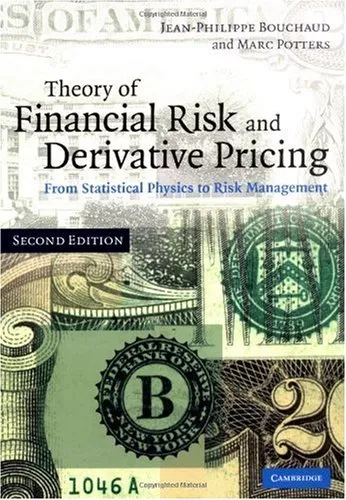
Theory of Financial Risk and Derivative Pricing: From Statistical Physics to Risk Management
Jean-Philippe Bouchaud,Marc Potters
English
Beginner
Corporate Finance
4.0 / 5
0 reviews
2004
Published
200
pages
652
views
Introduction Welcome to the intricate world of financial markets, where the interplay of risk and pricing challenges your understanding of economic phenomena. 'Theory of Financial Risk and Derivative Pricing: From Statistical Physics to Risk Management' is a groundbreaking
Before you read
What will you get from this book?
Introduction
Welcome to the intricate world of financial markets, where the interplay of risk and pricing challenges your understanding of economic phenomena. 'Theory of Financial Risk and Derivative Pricing: From Statistical Physics to Risk Management' is a groundbreaking book that bridges the gap between statistical physics and financial theories, providing a comprehensive framework for understanding financial risk and the complex mechanisms of derivative pricing. Authored by Jean-Philippe Bouchaud and Marc Potters, this book is a crucial addition to the library of anyone interested in the modern financial landscape, risk management, and quantitative finance.
Detailed Summary of the Book
The book begins by introducing the underlying concepts of statistical physics and illustrates how they can be applied to understanding financial markets. Taking a unique approach, Bouchaud and Potters diverge from traditional economic theories, drawing insights from the laws of thermodynamics and statistical mechanics to model financial systems. This interdisciplinary method enables a more realistic portrayal of market dynamics, challenging the assumptions of classical finance models.
As you progress through the book, you will encounter a thorough analysis of financial risk, the stochastic nature of markets, and the mathematical techniques used to quantify and mitigate risk. The authors explore how these methods can be applied to the pricing and hedging of financial derivatives, offering novel techniques that have been validated through empirical research.
The latter sections of the book delve into more advanced topics, including the application of random matrix theory in finance, the analysis of correlation among financial assets, and the limitations of risk models. Through detailed mathematical models and empirical data, the book provides valuable insights for building robust financial risk management strategies.
Key Takeaways
- The integration of physics-based models can provide a more accurate representation of financial market dynamics.
- Traditional models often fail to account for extreme events and market anomalies; therefore, innovative approaches are essential.
- Understanding the stochastic processes underlying financial markets is critical for effective risk management.
- Advanced mathematical tools, such as random matrix theory, can improve the accuracy of risk assessment and derivative pricing.
Famous Quotes from the Book
"Our goal is to guide the reader from the basic principles of statistical physics to the sophisticated notions needed to model financial risks."
"Financial markets are more akin to turbulent seas than to equilibrated systems—an insight borrowed from the world of physics."
Why This Book Matters
In contemporary finance, where markets are becoming increasingly complex and interconnected, traditional financial models often fall short. By leveraging concepts from statistical physics, this book provides a profound rethinking of market behavior that challenges established norms. It matters not only because it offers alternative methodologies but also because it equips financial practitioners with a wider array of tools for analyzing risk, which is vital in today's volatile environments.
This book also serves as an essential resource for academics, students, and professionals who aspire to contribute to the field of quantitative finance or enhance their understanding of risk management. Its interdisciplinary approach fosters innovation, inspiring new lines of inquiry that transcend the boundaries of conventional financial theories.
In summary, 'Theory of Financial Risk and Derivative Pricing' is more than a textbook; it is a paradigm shift in our understanding of finance. By weaving the principles of physics into the fabric of financial theory, Bouchaud and Potters offer readers a refreshing perspective that invites further exploration and development.
Ask this book
Your question is answered in the context of this title and author. Each answer uses 2 points.
Sign in to ask the book assistant.
Reader reviews
0 reviews, 4.0 average out of 5
No reviews yet
If you have read this book, help the next reader with your experience.
Write a review
Sign in to publish a review.
Reader questions and answers
Ask a focused question and learn from the community.
Sign in to ask or answer a question.
No questions yet
Be the first to ask a clear, useful question.
What to read next
Related references that continue this learning path.