
Computer Algebra in Scientific Computing: CASC 2000
Alkiviadis G. Akritas,Gennadi I. Malaschonok (auth.),Victor G. Ganzha,Ernst W. Mayr,Evgenii V. Vorozhtsov (eds.)
2000
View book
Book guide and evaluation
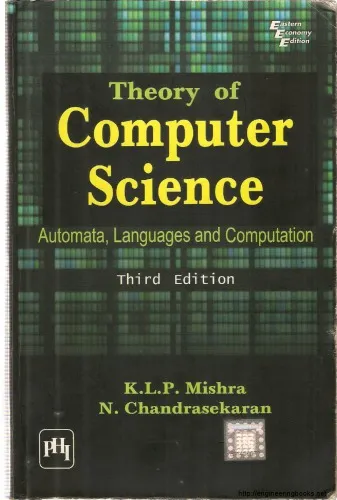
K. L. P. Mishra,N. Chandrasekaran
0 reviews
Published
pages
views
Introduction to 'Theory of Computer Science: Automata, Languages and Computation' Welcome to an exploration of computational theory through the 'Theory of Computer Science: Automata, Languages and Computation'. This book is an essential resource for anyone delving into the
Before you read
Welcome to an exploration of computational theory through the 'Theory of Computer Science: Automata, Languages and Computation'. This book is an essential resource for anyone delving into the rich field of theoretical computer science.
'Theory of Computer Science: Automata, Languages and Computation' is meticulously structured to guide readers through the fundamental and advanced concepts of theoretical computer science. With a clear focus on automata, formal languages, and computational models, the book serves both as an introductory text for students and as a solid reference for professionals and researchers.
The book begins with a thorough understanding of automata theory, which forms the foundational block for understanding other concepts. It systematically presents finite automata, regular languages, and their properties, alongside practical applications in computing.
As readers progress, the book delves deeper into context-free languages and pushdown automata, bridging theory with syntax design of programming languages. The discussion on Turing machines establishes a comprehensive foundation for understanding what can be computed in principle.
Further exploration into decidability and complexity theory enlightens readers about the profound limits of computation. The book also touches on contemporary topics like the Chomsky hierarchy and explores the nuances of computational efficiency and complexity classes.
A distinctive feature of this book is its balanced approach, combining theoretical depth with practical insights. Numerous problems, examples, and exercises enhance the learning experience, making complex ideas more accessible.
"The beauty of theoretical computer science lies in its ability to illuminate the seemingly abstract nature of computation in a tangible manner."
"Understanding automata is akin to learning the alphabets of the language of computation."
In an era where computation underpins almost every facet of innovation, understanding theoretical computer science is invaluable. This book matters because it not only equips readers with the knowledge of foundational computational theories but also inspires critical thinking about the future developments in technology.
The diligent structuring of complexities makes this book a benchmark in educational literature for computer science. It bridges the gap between theoretical exploration and practical application, making it a go-to resource for students, educators, and professionals alike.
Furthermore, as computational challenges grow in complexity and scope, the insights drawn from this book continue to be relevant, highlighting ongoing advancements and the evolving nature of computer science.
Your question is answered in the context of this title and author. Each answer uses 2 points.
0 reviews, 4.5 average out of 5
Sign in to publish a review.
Ask a focused question and learn from the community.
Related references that continue this learning path.
Alkiviadis G. Akritas,Gennadi I. Malaschonok (auth.),Victor G. Ganzha,Ernst W. Mayr,Evgenii V. Vorozhtsov (eds.)
Ahmed Bouajjani,Peter Habermehl,Yan Jurski,Mihaela Sighireanu (auth.),Erzsébet Csuhaj-Varjú,Zoltán Ésik (eds.)