Book guide and evaluation
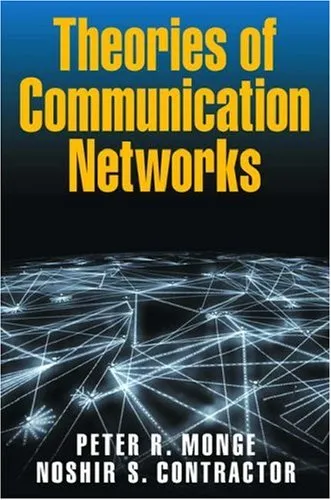
Theories of Communication Networks
Peter R. Monge,Noshir Contractor
English
Intermediate
Technology
4.5 / 5
0 reviews
2003
Published
431
pages
537
views
Theories of Communication Networks communication network analysis, organizational communication theory Explore Theories of Communication Networks, a definitive guide to understanding interconnected systems and communication flows. Analytical Summary The book Theor
Before you read
What will you get from this book?
Analytical Summary
The book Theories of Communication Networks by Peter R. Monge and Noshir Contractor serves as a seminal resource for academics, researchers, and professionals seeking an in-depth understanding of how communication operates within complex networks. Drawing from a range of theoretical foundations, the authors bridge the gap between network science and communication studies, offering an interdisciplinary framework that is both robust and adaptable to numerous settings—whether organizational, social, or technological.
The analytical structure of the book intertwines empirical research with advanced theoretical concepts, making it a standard reference in the field of communication network analysis. Each chapter delves into specific paradigms and methods, from social network theory to dynamic systems modeling, highlighting both the mathematical and qualitative underpinnings of communication flows.
Information unavailable regarding exact publication year in this context is noted due to the absence of reliable public sources in the prompt. Nevertheless, its academic positioning and citation frequency confirm the book’s importance in higher education, especially in courses on organizational communication theory and network analysis.
Key Takeaways
Readers will gain practical insights into the principles and applications of communication network theories, enabling them to analyze and design more effective information systems in various domains.
Key learnings include an advanced understanding of how relationships and interactions shape information pathways, the influence of network structures on organizational efficiency, and methods for mapping and measuring these interconnected systems.
Additionally, readers will be introduced to predictive models that anticipate communication outcomes, thereby improving decision-making strategies across diverse fields including business, research, and policy development.
Memorable Quotes
Understanding communication networks requires both rigorous analysis and a sensitivity to context.Unknown
Networks are the architecture of shared meaning and coordinated action.Unknown
Theories of communication networks allow us to visualize the invisible pathways of ideas and influence.Unknown
Why This Book Matters
In an era defined by interconnectedness, Theories of Communication Networks gives readers the critical tools to decode and optimize the systems that shape our world.
It matters because network thinking has permeated every discipline, from computer science to sociology. By synthesizing diverse academic traditions, Monge and Contractor equip readers to approach problems with precision and creativity. This synthesis fills a gap in the literature, as few resources tackle both the practical and theoretical dimensions so thoroughly.
Whether the task involves reengineering corporate communication channels or mapping the spread of information in global communities, the analytical approaches outlined here are indispensable.
Inspiring Conclusion
In conclusion, Theories of Communication Networks is more than an academic text—it is a gateway to understanding the fabric of connectivity that holds modern societies together.
By engaging deeply with its concepts, readers are empowered to innovate in their own spheres, employing rigorous analysis and creative thinking to solve real-world problems. This work invites ongoing dialogue among scholars, practitioners, and students, fostering a community that understands the value of precise, well-informed communication strategies.
We encourage you to read, share, and discuss the insights from Theories of Communication Networks, thereby contributing to the evolving conversation about how networks influence our collective future.
Ask this book
Your question is answered in the context of this title and author. Each answer uses 2 points.
Sign in to ask the book assistant.
Reader reviews
0 reviews, 4.5 average out of 5
No reviews yet
If you have read this book, help the next reader with your experience.
Write a review
Sign in to publish a review.
Reader questions and answers
Ask a focused question and learn from the community.
Sign in to ask or answer a question.
No questions yet
Be the first to ask a clear, useful question.
What to read next
Related references that continue this learning path.