
![Cover of Quantum physics of atoms, molecules, solids, nuclei, and particles [SOLUTIONS]](https://s3.refhub.ir/images/thumb/Quantum_physics_of_atoms__molecules__solids___16894.webp)
Quantum physics of atoms, molecules, solids, nuclei, and particles [SOLUTIONS]
Robert Martin Eisberg;Robert Resnick
1985
View book
Book guide and evaluation
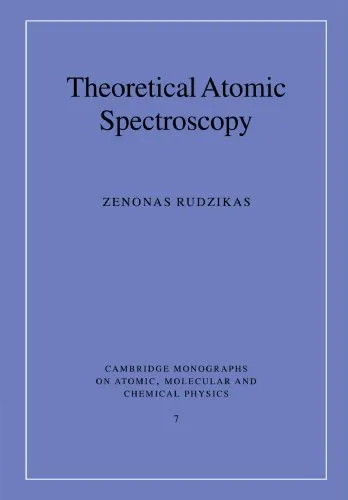
Zenonas Rudzikas
0 reviews
Published
pages
views
Introduction Welcome to Theoretical Atomic Spectroscopy, a profound exploration of the theoretical foundations and advanced methodologies that define the intricate world of atomic spectroscopy. Authored by Zenonas Rudzikas, this book serves as a seminal guide for physicist
Before you read
Welcome to Theoretical Atomic Spectroscopy, a profound exploration of the theoretical foundations and advanced methodologies that define the intricate world of atomic spectroscopy. Authored by Zenonas Rudzikas, this book serves as a seminal guide for physicists, chemists, and students engaged in atomic, molecular, and chemical physics, combining a rigorous mathematical approach with a clear conceptual framework necessary for understanding atomic spectra. With its detailed and systematic approach, this work bridges the gap between theoretical abstraction and real-world atomic phenomena.
Through its pages, readers will encounter the mathematical treatments of atomic energy levels, transitions, and interactions, with the principles derived from quantum mechanics forming the backbone of the discussion. The book ensures that both newcomers and seasoned researchers have a reference that is profoundly insightful and practical.
Theoretical Atomic Spectroscopy delves into the principles of atomic spectra and their applications using a comprehensive approach that emphasizes mathematical precision and physical clarity. Divided into coherent sections, the book first establishes the groundwork by introducing readers to fundamental atomic interactions and quantum mechanics concepts. It explores the role of external fields on atomic systems, offering exhaustive treatments of Stark and Zeeman effects.
A significant portion of the text is dedicated to the symmetries and group-theoretical methods that provide deep insights into the structure of multielectron atoms. Readers are guided through the derivation of matrix elements, spin-orbit interactions, and the implications of fine and hyperfine structures in atomic spectra. The book also addresses radiation theory, the principles of multiphoton processes, and the various approximations used in spectroscopic analysis.
Mathematical rigor is complemented by conceptual explanations, making the content accessible yet precise. The volume concludes with a discussion on practical applications in laboratory spectroscopy, astrophysics, and plasma diagnostics, demonstrating the indispensable role atomic spectroscopy plays across scientific disciplines.
"Atomic spectroscopy is not merely the study of light emitted by atoms; it is the window through which the deepest secrets of atomic structure and universal principles come into view."
"Symmetry in nature is not an artifact but a fundamental lens through which we decode the language of atoms."
"Mathematics and physics in tandem do not reveal the beauty of the atomic world; they immerse us in it."
Theoretical Atomic Spectroscopy stands out as a monumental contribution to the field of atomic physics. Its importance lies in its balanced approach that combines theoretical depth, mathematical rigor, and practical application. Whether you are a budding researcher or an experienced physicist, this book provides a foundation upon which further experimental and theoretical advancements can be built.
The work holds relevance beyond academia, influencing fields such as astrophysics, quantum technology, and plasma science. Its emphasis on symmetry, group theory, and atomic interactions makes it a timeless resource for anyone investigating the microscopic mechanisms governing the universe. The reader is not merely educated but empowered to explore new horizons in atomic spectroscopy, bridging the gap between foundational concepts and groundbreaking technologies.
By meticulously weaving quantum mechanics, mathematical formalisms, and experimental insights, Zenonas Rudzikas creates a text that endures as an essential guide for understanding one of physics' most fascinating areas: the atomic and molecular world.
Your question is answered in the context of this title and author. Each answer uses 2 points.
0 reviews, 4.0 average out of 5
Sign in to publish a review.
Ask a focused question and learn from the community.
Related references that continue this learning path.
Robert Martin Eisberg;Robert Resnick
D'Auria, Riccardo;Trigiante, Mario