

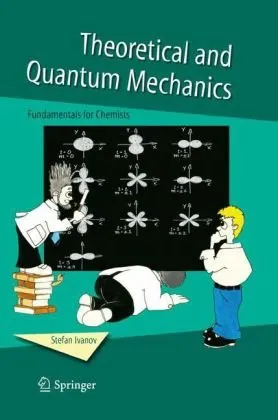
Book guide and evaluation
Theoretical and Quantum Mechanics-Fundamentals for Chemists
Stefan Ivanov
English
Beginner
Physics
3.5 / 5
0 reviews
2005
Published
522
pages
222
views
Introduction to "Theoretical and Quantum Mechanics - Fundamentals for Chemists" "Theoretical and Quantum Mechanics - Fundamentals for Chemists" is a concise yet comprehensive exploration of the theoretical foundations of quantum mechanics tailored specifically for chemists
Before you read
What will you get from this book?
Introduction to "Theoretical and Quantum Mechanics - Fundamentals for Chemists"
"Theoretical and Quantum Mechanics - Fundamentals for Chemists" is a concise yet comprehensive exploration of the theoretical foundations of quantum mechanics tailored specifically for chemists and students of chemistry. As a bridge between abstract mathematical formalism and practical applications in chemistry, this book was designed to unravel the complexities of quantum mechanics and make them accessible without sacrificing scientific depth or accuracy.
Whether you are a chemistry undergraduate beginning your journey into the quantum world or a seasoned researcher seeking to revisit foundational concepts, this book provides a clear roadmap through the intricate landscape of quantum mechanics. Written with clarity and precision, the text highlights the essential theories, equations, and principles that govern molecular and atomic interactions at the quantum level. By blending theoretical rigor with practical examples, this work serves both as a reference guide and a learning companion, ensuring readers grasp not only the “how” but also the “why” of quantum mechanical concepts as they apply to chemistry.
Throughout its pages, the book achieves a balance between concept and application. Key quantum frameworks such as wave-particle duality, the Schrödinger equation, operators, quantum states, and perturbation theory are explored in the context of their relevance to chemical systems. This makes the book not only an enriching theoretical guide but also a valuable resource for practical computational chemistry and spectroscopy.
Detailed Summary of the Book
At its core, "Theoretical and Quantum Mechanics - Fundamentals for Chemists" is divided into progressive sections that build upon one another to deepen the reader's understanding of key theoretical principles.
The text begins by examining the historical evolution of quantum mechanics, starting with foundational concepts such as classical mechanics and the emergence of quantum theory. This historical journey sets the stage for understanding the limitations of classical approaches in explaining phenomena like black-body radiation and the photoelectric effect.
Subsequent chapters delve into quantum mechanics' postulates, including wavefunctions, operators, and the concept of superposition. Special care is given to clarifying the mathematical tools used in quantum theory, such as linear algebra and differential equations, ensuring accessibility for chemists who may not have a strong mathematical background. Key topics like the Heisenberg Uncertainty Principle, quantum tunneling, and eigenstate solutions to the Schrödinger Equation are examined with detailed derivations and examples.
The latter portions of the book focus on applications in chemical contexts. Molecular orbital theory, quantum chemical calculations, spectroscopy, and reaction dynamics are thoroughly explained using quantum principles. Real-world examples and exercises challenge readers to apply their understanding to predict molecular behavior, analyze spectroscopic data, and interpret chemical reactivity.
Key Takeaways
- A solid understanding of quantum mechanics' postulates and mathematical foundations.
- Practical insights into how quantum mechanics governs chemical systems.
- The relationship between theoretical models and experimental observations in chemistry.
- Frameworks for interpreting spectroscopy, molecular orbitals, and reaction dynamics.
- Exercises and examples designed to cultivate problem-solving skills in quantum chemistry.
Famous Quotes from the Book
"Quantum mechanics is not merely a set of equations—it is the language through which the universe expresses its subtleties, and chemistry is its most eloquent dialect."
"In every chemical bond lies the beauty of quantum mechanics; it is both predictable and enigmatic, tangible yet profoundly abstract."
Why This Book Matters
"Theoretical and Quantum Mechanics - Fundamentals for Chemists" stands out as a vital resource for both budding chemists and experienced professionals seeking to master quantum foundations. Here’s why:
Quantum mechanics lies at the heart of modern chemistry, dictating the behavior of atoms and molecules. Yet, for many, the subject remains intimidating due to its abstract theories and mathematical intricacies. This book aims to demystify quantum mechanics by presenting it through a chemist’s lens. By fully understanding these principles, chemists can unlock deeper insights into molecular structures, reactivity, and properties.
Moreover, the book bridges the gap between theory and application. While many textbooks dwell either on abstract mathematics or simplified chemistry examples, this book combines both, emphasizing quantum mechanics' relevance in real-world chemical problems.
Lastly, this work also serves as a reminder that chemistry is fundamentally quantum in nature. By mastering quantum mechanics, chemists gain the tools to not only interpret the universe's building blocks but also innovate in fields like nanotechnology, materials science, and biophysics.
Ask this book
Your question is answered in the context of this title and author. Each answer uses 2 points.
Sign in to ask the book assistant.
Reader reviews
0 reviews, 3.5 average out of 5
No reviews yet
If you have read this book, help the next reader with your experience.
Write a review
Sign in to publish a review.
Reader questions and answers
Ask a focused question and learn from the community.
Sign in to ask or answer a question.
No questions yet
Be the first to ask a clear, useful question.
What to read next
Related references that continue this learning path.


Modern Computer Vision with PyTorch: A Practical Roadmap From Deep Learning Fundamentals to Advanced Applications and Generative AI, 2nd Edition
V Kishore Ayyadevara,Yeshwanth Reddy
2023
View book