

Conflict and Compromise: The Strategy, Politics and Diplomacy of the French Blockade, 1914–1918
Marjorie Milbank Farrar (auth.)
1974
View book
Book guide and evaluation
Sarah R. Coleman
0 reviews
Published
pages
views
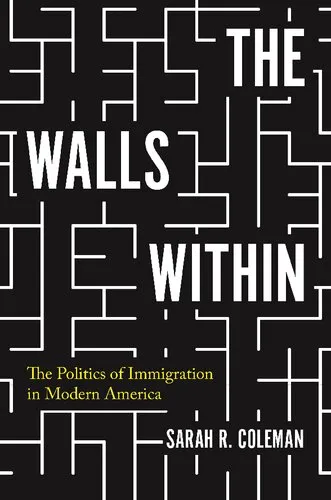
Introduction to 'The Walls Within: The Politics of Immigration in Modern America' Immigration has always been a defining element in the growth and transformation of the United States, yet it remains one of the most divisive and politically charged aspects of modern America
Before you read
Immigration has always been a defining element in the growth and transformation of the United States, yet it remains one of the most divisive and politically charged aspects of modern American life. In The Walls Within: The Politics of Immigration in Modern America, Sarah R. Coleman unpacks the complex history of immigration reform, focusing on how domestic policies over several decades have reshaped the rights of immigrants and altered the core tenets of American citizenship.
The book provides a thought-provoking examination of how the interplay between political ideologies, economic interests, and national security concerns have constructed not only physical barriers but also legal and bureaucratic walls within the country. Offering detailed historical analysis, the book reveals the consequences of these decisions and their effects on immigrant communities, working-class Americans, and the broader societal fabric. It is an essential read for anyone seeking to understand why immigration policy still fuels such fierce debate in the United States today.
Structured chronologically, The Walls Within focuses on several key moments in late 20th and early 21st-century American history when immigration policy became a pivotal political battleground. Coleman highlights how immigrant rights within the United States became increasingly restricted through policies that blurred the lines between federal and state jurisdictions. She examines critical legislation, such as the Immigration Reform and Control Act (IRCA) of 1986 and the Personal Responsibility and Work Opportunity Reconciliation Act of 1996, exploring their impact on immigrant labor, civil rights, and access to public benefits.
At the heart of the book is the argument that immigration policies do not merely regulate who can enter or stay in the country—they also shape what it means to belong. Coleman provides insight into how programs such as 287(g), which allows local law enforcement to enforce certain immigration laws, complicated the relationship between immigrant communities and state authorities. The book also discusses how these policies exacerbated inequalities, curbing economic opportunities for immigrants and creating a culture of exclusion.
Through meticulous research, Coleman delves into the roles of key players—politicians, activists, employers, and state actors—in influencing immigration law and its enforcement. She connects the dots to demonstrate how domestic policy arenas such as welfare, labor rights, and education have been weaponized to manage immigration, often disproportionately impacting marginalized groups.
The Walls Within is more than just a historical account of immigration policy—it’s a critical lens through which to view current debates over border security, sanctuary cities, and immigrant rights. Coleman provides a nuanced understanding of the political and economic forces that shape these policies, revealing their broader implications for democratic principles and equality.
As immigration continues to be a polarizing issue in American politics, this book serves as a vital resource for policymakers, scholars, activists, and the general public. It connects past legislative developments to contemporary dilemmas, making the argument that immigration policy is not just about who can cross lines on a map—it’s about defining the promises and limitations of American citizenship itself.
By focusing on policy areas often overlooked in broader immigration debates, the book challenges common narratives and invites readers to reconsider the relationship between immigration and the American identity. In a world where debates over borders, belonging, and basic human rights persist, The Walls Within is an essential guide for understanding how decisions made decades ago continue to influence millions of lives today.
Your question is answered in the context of this title and author. Each answer uses 2 points.
0 reviews, 4.5 average out of 5
Sign in to publish a review.
Ask a focused question and learn from the community.
Related references that continue this learning path.
Marjorie Milbank Farrar (auth.)
Elbridge A. Colby

Friedel Bolle,Marco Lehmann-Waffenschmidt (auth.),Professor Dr. Friedel Bolle,Professor Dr. Marco Lehmann-Waffenschmidt (eds.)