A Concise Introduction to Elastic Solids: An Overview of the Mechanics of Elastic Materials and Structures
Carl T. Herakovich (auth.)
2017
View book
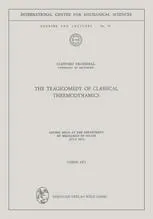
Book guide and evaluation
Clifford Truesdell (auth.)
0 reviews
Published
pages
views
Introduction "The Tragicomedy of Classical Thermodynamics: Course Held at the Department of Mechanics of Solids (July 1971)" is an insightful exploration into the complex and often misunderstood realm of classical thermodynamics—a subject that sits
Before you read
"The Tragicomedy of Classical Thermodynamics: Course Held at the Department of Mechanics of Solids (July 1971)" is an insightful exploration into the complex and often misunderstood realm of classical thermodynamics—a subject that sits at the heart of physical sciences and engineering. Authored by Clifford Truesdell, a distinguished figure in the field, this book delves into the nuances and intricacies that have shaped the study of thermodynamics, offering readers both a historical context and a thorough examination of its foundational principles.
Clifford Truesdell's work is both a critical analysis and an homage to the evolution of classical thermodynamics. He examines its trajectory from its 19th-century origins to its present-day applications. The book is structured in a way that unfolds the narrative of thermodynamic theories, discussing the nature and scope of energy, entropy, and the laws that govern these phenomena.
Throughout the text, Truesdell challenges the reader to reconsider commonly held assumptions, posing thoughtful critiques of traditional interpretations. By weaving a historical narrative, he highlights key figures and pivotal moments that have greatly influenced the development of thermodynamic thought. His detailed examinations of foundational laws and equations provide students and professionals alike with a deeper understanding of the subject’s intricacies.
Throughout his book, Truesdell offers numerous thought-provoking passages that capture the essence of thermodynamic study. Here are a few:
“The laws of thermodynamics appear simple, yet they encompass the profound intricacies of the universe.”
“Understanding the history of thermodynamics is not merely academic; it is a voyage into the very evolution of scientific thought.”
"The Tragicomedy of Classical Thermodynamics" is not just a technical manual, but rather a narrative that bridges the gap between classical and modern approaches to thermodynamics. Truesdell’s rigorous yet accessible writing style makes complex concepts approachable, making this book invaluable for both students and seasoned scholars.
The book highlights the dramatic interplay between scientific rigor, historical context, and philosophical inquiry, aspects that together weave the fabric of modern scientific understanding. It serves as both a scholarly resource and a guide, challenging readers to rethink the way they perceive the natural world and its governing laws.
In sum, Truesdell's exploration into thermodynamics is foundational, providing framework and perspective to a field that continues to evolve, guided by its rich past and enterprising future.
Your question is answered in the context of this title and author. Each answer uses 2 points.
0 reviews, 4.7 average out of 5
Sign in to publish a review.
Ask a focused question and learn from the community.
Related references that continue this learning path.
Carl T. Herakovich (auth.)

Yunus Cengel,Michael Boles