
Book guide and evaluation
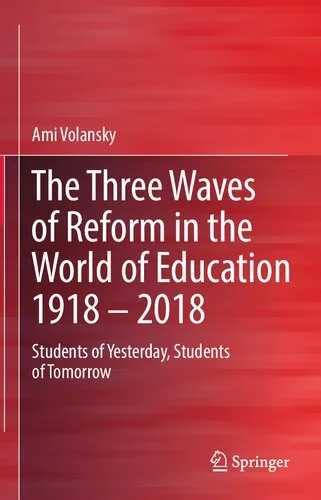
The Three Waves of Reform in the World of Education 1918 – 2018: Students of Yesterday, Students of Tomorrow
Ami Volansky
English
Unordered
novel
4.4 / 5
0 reviews
2023
Published
488
pages
296
views
This book reviews one hundred years of educational reforms worldwide. Characterized by a tension between governing public and professional forces, the waves of educational reform reflect myriad efforts to define and fulfill professional and public expectations for the world of ed
Before you read
What will you get from this book?
This book reviews one hundred years of educational reforms worldwide. Characterized by a tension between governing public and professional forces, the waves of educational reform reflect myriad efforts to define and fulfill professional and public expectations for the world of education. The first wave of reform, based on “progressive” ideals, spread across the globe after World War I, striving to place the student at the center of the education process and respond to the diverse needs of children and youth in a world that included massive population shifts. The second wave nearly obliterated the ideals of the progressive movement that had prevailed for sixty years. Drawing its principles from the business world, the second wave imposed competition, uniform standards, and measurable outputs on students, teachers, and schools, even at the cost of harming at-risk populations and encouraging the infiltration of private sector values into public education systems.The third wave was launched at the turn of the twenty-first century. Seeking to adjust instructional methods to modern reality, this reform rejected standardized curricula in favor of developing skills such as independent thinking, curiosity, innovation, collaboration among learners, and the ability to mine and process information. Book I reviews the three waves of reform in the United States, England, Canada, Japan, Singapore, Hong Kong, Australia, and Finland. Book II focuses on Israel’s education system — past, present, and future.
Ask this book
Your question is answered in the context of this title and author. Each answer uses 2 points.
Sign in to ask the book assistant.
Reader reviews
0 reviews, 4.4 average out of 5
No reviews yet
If you have read this book, help the next reader with your experience.
Write a review
Sign in to publish a review.
Reader questions and answers
Ask a focused question and learn from the community.
Sign in to ask or answer a question.
No questions yet
Be the first to ask a clear, useful question.
What to read next
Related references that continue this learning path.
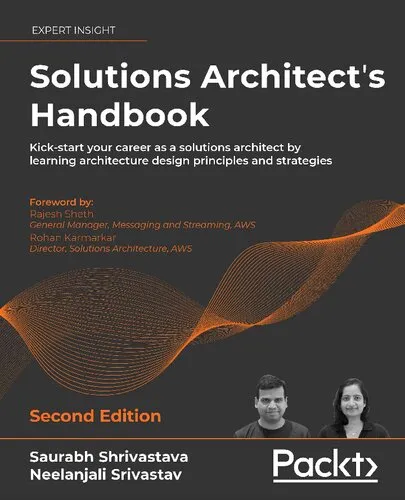
Solutions Architect's Handbook: Kick-start your career as a solutions architect by learning architecture design principles and strategies, 2nd Edition
Saurabh Shrivastava,Neelanjali Srivastav
2022
View book
Solutions Architect's Handbook - Third Edition: Kick-start your career with architecture design principles, strategies, and generative AI techniques
Saurabh Shrivastava,Neelanjali Srivastav
2024
View book