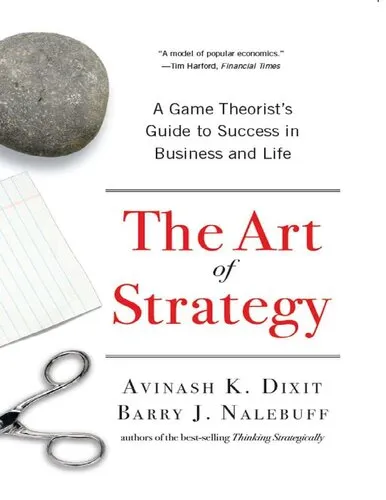
The Art of Strategy: A Game Theorist's Guide to Success in Business and Life
Avinash K. Dixit,Barry J. Nalebuff
2008
View book
Book guide and evaluation
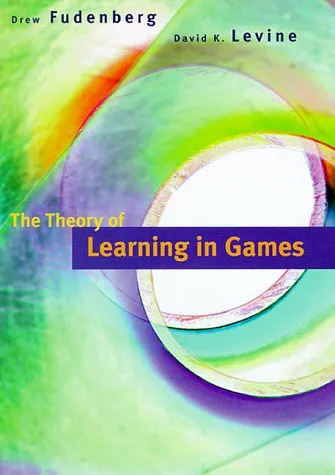
Drew Fudenberg,David K. Levine
0 reviews
Published
pages
views
Introduction Welcome to the intriguing world of strategic reasoning and dynamic learning mechanisms with The Theory of Learning in Games, a groundbreaking book authored by Drew Fudenberg and David K. Levine. This book delves into the intersection of game theory and learning, o
Before you read
Welcome to the intriguing world of strategic reasoning and dynamic learning mechanisms with The Theory of Learning in Games, a groundbreaking book authored by Drew Fudenberg and David K. Levine. This book delves into the intersection of game theory and learning, offering an analytical framework to study how agents, with bounded rationality, learn and adapt their behaviors in strategic environments over time. Aimed at both academics and practitioners, it sheds light on the iterative processes by which equilibrium concepts emerge and evolve in repeated games and multi-agent systems.
Fudenberg and Levine challenge conventional equilibrium models by exploring how these often long-run equilibrium outcomes are the product of short-term adaptations, experimentation, and learning. By combining economic theory with insights from psychology, computer science, and mathematics, the authors address critical questions: How do learning processes work in a world of uncertainty? How do individuals and groups of agents reach equilibrium solutions over repeated interactions? And how do bounded rational players—those with limited cognitive resources—make decisions over time?
This book provides a rigorous yet accessible foundation for understanding the complex dynamics of learning in games. It’s a must-read for anyone interested in economics, game theory, artificial intelligence, or decision-making sciences.
The book begins by challenging the traditional static approach to game theory, which presumes players rationally compute equilibrium strategies all at once. Instead, it introduces dynamic learning models where players use past experiences to gradually adjust their strategies. It carefully transitions from classical concepts, such as Nash equilibrium, and contextualizes them within adaptive processes.
Key topics covered in the book include:
Throughout the text, Fudenberg and Levine adopt a methodical approach and support their arguments with formal proofs, practical examples, and illustrative insights. Whether you’re a mathematician, social scientist, or AI researcher, the book’s combination of theory, context, and discussion strikes a balance between accessibility and technical depth.
"Equilibrium is not something to be assumed; it is something to be explained through the analysis of learning dynamics."
"The players we observe in reality are human beings, not flawless maximizers; thus, bounded rationality and learning must be integral to any useful framework of game theory."
"The process of learning itself can shape strategic behavior in profound ways, challenging the static assumptions of classical equilibrium theory."
The relevance of The Theory of Learning in Games stems from its ability to bridge the gap between theoretical constructs and real-world behavior. Traditional game theory has been criticized for its reliance on static equilibrium concepts that assume perfect rationality and foresight. This book addresses these criticisms by focusing on dynamic and realistic models of learning.
In an era driven by artificial intelligence and machine learning, the questions posed by this book have never been more pressing. Understanding how agents learn in complex and uncertain environments has implications for designing intelligent systems, optimizing economic policies, and improving negotiation strategies.
Moreover, its interdisciplinary approach makes it invaluable for researchers beyond economics, including those in social sciences, biology, and computer science. By offering a unified view of learning dynamics, Fudenberg and Levine have provided a timeless intellectual framework that continues to influence theoretical advancements and practical applications in the study of games.
Your question is answered in the context of this title and author. Each answer uses 2 points.
0 reviews, 4.5 average out of 5
Sign in to publish a review.
Ask a focused question and learn from the community.
Related references that continue this learning path.
Avinash K. Dixit,Barry J. Nalebuff