

Book guide and evaluation
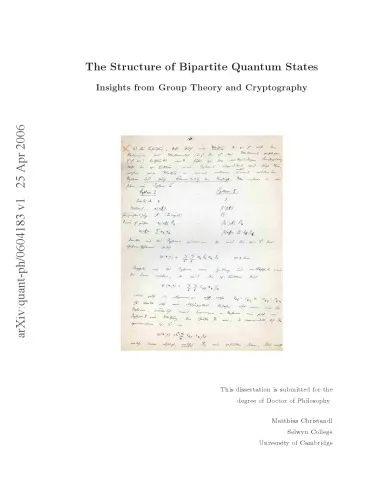
The structure of bipartite quantum states : insights from group theory and cryptography
Matthias Christandl; University of Cambridge. Dept. of Applied MathematicsandTheoretical Physics
English
Beginner
Art
4.7 / 5
0 reviews
2006
Published
218
pages
135
views
The Structure of Bipartite Quantum States: Insights from Group Theory and Cryptography Quantum mechanics and information theory are two fields that have transformed our understanding of the universe, from the most fundamental aspects of physics to the cutting-edge te
Before you read
What will you get from this book?
The Structure of Bipartite Quantum States: Insights from Group Theory and Cryptography
Quantum mechanics and information theory are two fields that have transformed our understanding of the universe, from the most fundamental aspects of physics to the cutting-edge technologies driving the future. In "The Structure of Bipartite Quantum States: Insights from Group Theory and Cryptography", I explore the intricate world of bipartite quantum states through a mathematical and conceptual lens informed by group theory and modern cryptographic principles.
This book serves as a bridge between the abstract theories of quantum information and their practical implications in computation, communication, and security. Designed for researchers, students, and enthusiasts of quantum mechanics, it combines deep mathematical rigor with intuitive insights, ensuring readers of varying expertise levels can gain valuable knowledge.
Whether you are interested in the role of symmetry in understanding quantum states, or you strive to decode the links between information-theoretic security and quantum properties, this book offers a comprehensive account of the subject matter. Constructed around mathematical elegance and physical insight, it reveals how the interplay between mathematics and quantum physics can illuminate the foundations of technology and science.
A Detailed Summary of the Book
The study of quantum states, particularly bipartite systems, is a cornerstone of modern quantum science. Bipartite quantum states involve systems that consist of two distinct but interrelated subsystems. Their properties are critical for understanding phenomena such as entanglement and for developing applications in quantum technologies, such as quantum computing and quantum communication.
The book begins by laying the groundwork in quantum information theory, introducing the mathematical tools necessary for the study of bipartite systems. It then delves into group theory as a powerful framework to analyze symmetries and structures within quantum states. By utilizing group-theoretic concepts, the text unveils hidden patterns and properties in quantum operations and state space, providing a deeper understanding that surpasses classical interpretations of mathematical symmetry.
From there, the book transitions to cryptographic perspectives. It examines how bipartite quantum systems relate to secure communication, analyzing protocols such as quantum key distribution (QKD) and their connection to quantum state properties. By juxtaposing physical principles with cryptographic applications, the book highlights the indispensability of bipartite states in achieving secure and efficient information exchange.
Topics such as state distinguishability, entanglement measures, and separability criteria are covered extensively. The book also discusses the Schmidt decomposition, LOCC (local operations and classical communication) protocols, and other innovative methods central to the study of quantum systems. Through a mixture of proofs, examples, and applications, the text ensures a holistic understanding of the subject.
Key Takeaways
- The interplay between group theory and quantum mechanics can provide unexpected insights into the structure and behavior of quantum states.
- Understanding bipartite quantum states is not just a theoretical pursuit but also crucial for practical applications like quantum communication and security.
- Fundamental concepts such as entanglement, separability, and quantum measurement can be explored effectively using mathematical and cryptographic frameworks.
- The study of bipartite states is critical for bridging quantum physics and real-world technology, specifically in systems that rely on secure data transmission.
- Methods such as the Schmidt decomposition and LOCC are indispensable tools for analyzing and manipulating quantum states.
Famous Quotes from the Book
"Quantum entanglement is not merely a feature of quantum mechanics; it is the very signature of nature's underlying non-classical logic."
"Group theory reveals symmetry not just in the physical world but in the abstract mathematical space of quantum states, unveiling profound connections."
"Cryptography and quantum mechanics, perhaps unexpectedly, speak a common language: one of uncertainty, security, and hidden structure."
Why This Book Matters
As quantum computing moves from theory to reality, understanding the structure of quantum states becomes of paramount importance. Bipartite quantum states, in particular, form the building blocks for entanglement-based quantum protocols and computations, positioning them as critical subjects for researchers and engineers alike. By uniting group theory, quantum mechanics, and cryptography, this book provides a unique and comprehensive framework for tackling some of the most fundamental questions in quantum science.
In addition, the book enriches readers with practical tools for exploring the separability and entanglement of states. The rigorous yet approachable style ensures accessibility without sacrificing depth, distinguishing this work from standard texts in the field. Students and professionals studying quantum theory will find this book an invaluable resource, while its focus on real-world applications extends its relevance to experimentalists and industry practitioners.
Overall, "The Structure of Bipartite Quantum States: Insights from Group Theory and Cryptography" is more than a technical exploration; it is a call to understand and leverage the profound structures governing our quantum world.
Ask this book
Your question is answered in the context of this title and author. Each answer uses 2 points.
Sign in to ask the book assistant.
Reader reviews
0 reviews, 4.7 average out of 5
No reviews yet
If you have read this book, help the next reader with your experience.
Write a review
Sign in to publish a review.
Reader questions and answers
Ask a focused question and learn from the community.
Sign in to ask or answer a question.
No questions yet
Be the first to ask a clear, useful question.
What to read next
Related references that continue this learning path.



Modern Computer Vision with PyTorch: A Practical Roadmap From Deep Learning Fundamentals to Advanced Applications and Generative AI, 2nd Edition
V Kishore Ayyadevara,Yeshwanth Reddy
2023
View book