

Book guide and evaluation
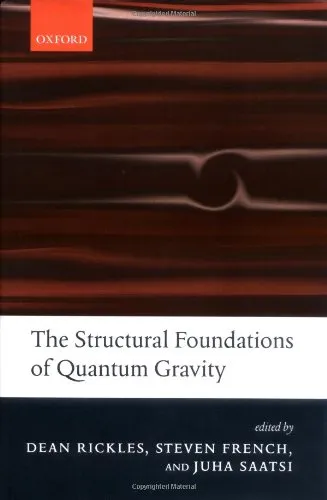
The structural foundations of quantum gravity
Dean Rickles,Steven French,Juha T. Saatsi
English
Beginner
Physics
4.0 / 5
0 reviews
2006
Published
282
pages
125
views
Welcome to 'The Structural Foundations of Quantum Gravity,' an insightful exploration of one of the most profound topics in contemporary physics and philosophy of science. Authored by Dean Rickles, Steven French, and Juha T. Saatsi, this book examines the intricate interplay be
Before you read
What will you get from this book?
Welcome to 'The Structural Foundations of Quantum Gravity,' an insightful exploration of one of the most profound topics in contemporary physics and philosophy of science. Authored by Dean Rickles, Steven French, and Juha T. Saatsi, this book examines the intricate interplay between quantum mechanics, general relativity, and structural realism, seeking to illuminate the foundational underpinnings of quantum gravity. By bridging physics and philosophy, it offers readers a fresh perspective on the challenges and opportunities presented by attempts to unify these two fundamental pillars of modern science.
Detailed Summary of the Book
The book is a multidisciplinary collaboration that engages both physicists and philosophers in an effort to address the complex questions underlying quantum gravity. It serves as a comprehensive investigation into how structural realism—a philosophical stance that emphasizes the structural relationships rather than the individual entities—is well-suited for grappling with the conceptual challenges posed by quantum gravity. The authors argue that the traditional object-based metaphysics of particles and fields struggles to provide a coherent foundation for theories that attempt to merge general relativity and quantum mechanics.
Beginning with a critique of classical metaphysical approaches, the book delves into various interpretations and methodologies for interpreting spacetime and quantum phenomena. Chapters explore metaphysical frameworks like ontic structural realism, the ontology of spacetime, the role of symmetries in physical theories, and how mathematics relates to the physical content of quantum theories. The authors also assess quantum field theory and string theory in the context of structural realism, shedding new light on their conceptual foundations.
Finally, the authors propose that looking at quantum gravity from the perspective of structural realism offers a richer and more productive avenue for solving its deeply rooted conceptual and technical problems. They argue that the structural approach avoids some traditional pitfalls of particle and substance-based metaphysics, making it a promising foundation for new breakthroughs.
Key Takeaways
- Structural realism is presented as an ideal philosophical framework for navigating the conceptual challenges of quantum gravity.
- The book bridges the gap between two historically opposed paradigms—general relativity and quantum mechanics—using a realist outlook grounded in structure rather than entities.
- Spacetime, symmetries, and quantum fields are reinterpreted through the lens of structural realism, offering fresh insights into their relationships and roles in physics.
- Quantum gravity involves a shift in how we think about the fundamental nature of reality, moving away from a particle-centered ontology to one based on networked relationships and mathematical structures.
- The integration of physics and philosophy provides a robust intellectual toolkit for tackling interdisciplinary challenges in modern science.
Famous Quotes from the Book
"If we are to unify general relativity and quantum mechanics, we must relinquish the comforting intuitions of classical metaphysics and embrace the relational and structural aspects of reality."
"Quantum gravity demands not only a fusion of physical theories but also a reevaluation of the metaphysical foundations that underpin our understanding of existence."
"The universe, at its most fundamental level, does not consist of things, but structures and relationships waiting to be discovered."
Why This Book Matters
'The Structural Foundations of Quantum Gravity' is not just a theoretical treatise; it is a groundbreaking dialogue between two disciplines—physics and philosophy—that are often kept apart. In addressing the divide between general relativity and quantum mechanics, the authors provide innovative ways to rethink some of the most fundamental questions about the nature of spacetime and matter. The book's focus on structuralism is particularly significant in light of the recent advances in theoretical physics, such as developments in string theory and approaches to loop quantum gravity.
By presenting a unified framework that can accommodate modern physics' most complex ideas, the authors provide a roadmap for future investigations into quantum gravity. Their interdisciplinary approach fosters collaboration and cross-pollination of ideas between physicists, philosophers, and mathematicians. For readers fascinated by the quest for a deeper understanding of the universe's fundamental nature, this book represents a quintessential resource.
Ultimately, this work sheds light on the profound implications quantum gravity has for both science and our philosophical understanding of reality. It challenges conventional thinking and invites readers to embrace a bold, structuralist vision of the future of physics. Whether you are a scientist, philosopher, or curious mind, 'The Structural Foundations of Quantum Gravity' is a must-read for gaining new insights into the most ambitious scientific endeavor of our time.
Ask this book
Your question is answered in the context of this title and author. Each answer uses 2 points.
Sign in to ask the book assistant.
Reader reviews
0 reviews, 4.0 average out of 5
No reviews yet
If you have read this book, help the next reader with your experience.
Write a review
Sign in to publish a review.
Reader questions and answers
Ask a focused question and learn from the community.
Sign in to ask or answer a question.
No questions yet
Be the first to ask a clear, useful question.
What to read next
Related references that continue this learning path.


Modern Computer Vision with PyTorch: A Practical Roadmap From Deep Learning Fundamentals to Advanced Applications and Generative AI, 2nd Edition
V Kishore Ayyadevara,Yeshwanth Reddy
2023
View book