

Building Better Minds: Artificial General Intelligence via the CogPrime Architecture
Ben Goertzel;Cassio Pennachin;Nil Geisweiller;OpenCog Team
2012
View book
Book guide and evaluation
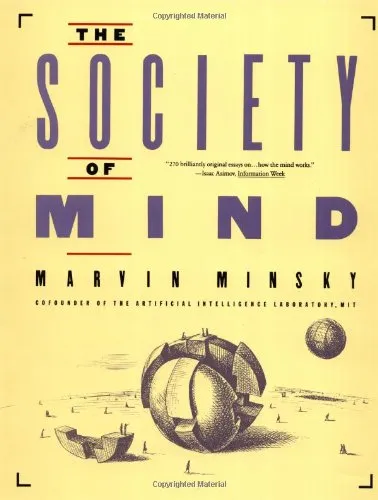
Marvin Minsky
0 reviews
Published
pages
views
Welcome to an exploration of artificial intelligence and human cognition through 'The Society of Mind' authored by the pioneering thinker, Marvin Minsky. This seminal work powerfully encapsulates how individual parts of the mind work collectively to create a unified sense of
Before you read
Welcome to an exploration of artificial intelligence and human cognition through 'The Society of Mind' authored by the pioneering thinker, Marvin Minsky. This seminal work powerfully encapsulates how individual parts of the mind work collectively to create a unified sense of consciousness.
In 'The Society of Mind', Marvin Minsky proposes a revolutionary theory of how our minds are constructed. Minsky breaks down mental functions into simple components or "agents" that interact to perform complex tasks. Each agent may not have individual intelligence, but collectively they orchestrate profound cognitive processes.
The structure of the book itself reflects this intricate web. Comprising 270 interrelated essays, Minsky delves into concepts such as memory, emotions, language, creativity, and logic. He argues that the mind is, essentially, an assembly of little machinery that works so seamlessly that it gives the illusion of coherent thought and personality.
Minsky's work transcends conventional neuroscience and philosophy, leveraging analogies from computer science, psychology, and sociology. By suggesting that minds do not emerge from single indivisible entities, but from systems working in synchronicity, the book presents the human mind in terms similar to a complex computer system.
"No computer has ever been designed that is ever aware of what it's doing; but most of the time, we aren't either."
"We can only see a short distance ahead, but we can see plenty there that needs to be done."
'The Society of Mind' is not just theoretical. Its implications for artificial intelligence and cognitive sciences are profound. Minsky’s work lays foundational principles for understanding complex systems which can be applied to machine intelligence, stressing the significance of collaborative functionalities.
In an era where AI is rapidly progressing, this book holds insights into not just building smarter machines but understanding human thought processes. It encourages viewing cognition as emergent properties arising from complex interactions, influencing fields beyond computer science, to psychology and philosophy.
Your question is answered in the context of this title and author. Each answer uses 2 points.
0 reviews, 4.6 average out of 5
Sign in to publish a review.
Ask a focused question and learn from the community.
Related references that continue this learning path.
Ben Goertzel;Cassio Pennachin;Nil Geisweiller;OpenCog Team


Stuart Russell,Peter Norvig
Diego Rasskin-Gutman,Deborah Klosky (transl.)