
Book guide and evaluation
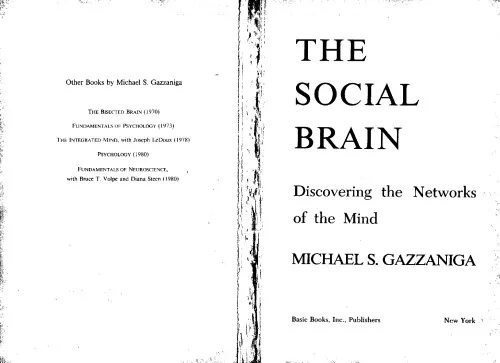
The social brain: discovering the networks of the mind
Michael S. Gazzaniga
English
Advanced
Politics
4.3 / 5
0 reviews
1985
Published
116
pages
546
views
In the ever-evolving field of neuroscience, understanding the intricacies of the human brain and its connection to social behaviors remains a captivating challenge. "The Social Brain: Discovering the Networks of the Mind" by Michael S. Gazzaniga delves into this multifaceted qu
Before you read
What will you get from this book?
In the ever-evolving field of neuroscience, understanding the intricacies of the human brain and its connection to social behaviors remains a captivating challenge. "The Social Brain: Discovering the Networks of the Mind" by Michael S. Gazzaniga delves into this multifaceted quest. Through a scientific lens, the book reveals the complexities of the brain's neural networks and how they influence social interactions and decision-making.
Detailed Summary of the Book
The book explores the intricate tapestry of brain networks that govern social cognition and behavior. Gazzaniga begins by drawing attention to the fundamental question of how individual neuron activities culminate in complex social behaviors. Through an exploration of the latest research and case studies, he articulates how the brain's architecture is inherently social. Detailed insights depict how neural circuits integrate emotions, memories, and environmental feedback to facilitate communication and understanding among individuals.
Gazzaniga emphasizes the role of specific brain regions, such as the prefrontal cortex, in managing social interactions and moral reasoning. Further, he elucidates how social networks within the brain can be disrupted, leading to a range of neurological and psychiatric conditions. By focusing on the brain's adaptability and plasticity, the book provides an enlightening perspective on how innate social functions evolve through life experiences and cultural influences.
Key Takeaways
- The brain's structure and function are fundamentally designed for social interaction.
- Complex behaviors arise from dynamic neural networks rather than isolated brain regions.
- Social cognition is not only a psychological construct but also a neuroscience challenge.
- The capability for empathy and moral judgment is deeply rooted in brain architecture.
- Environmental factors can significantly modify or reshape the brain's neural circuits involved in social behavior.
Famous Quotes from the Book
"Understanding the self requires an understanding of the social brain." This quote encapsulates the central theme of the book, emphasizing the deep interconnection between individual identity and the social environment.
"In every interaction, the brain is not just reacting to social stimuli but actively constructing reality." By portraying the brain as an active participant in crafting social experiences, this quote highlights the proactive nature of brain networks in our daily encounters.
Why This Book Matters
"The Social Brain: Discovering the Networks of the Mind" serves as an essential contribution to both neuroscience and psychology. At a time when understanding mental health and social disorders is increasingly critical, Gazzaniga's exposition offers invaluable perspectives on the neurological foundations of these issues. By integrating interdisciplinary research, the book bridges the gap between biological sciences and social sciences, laying the groundwork for future explorations in understanding human behavior.
This work is significant for educators, clinicians, and anyone interested in the brain's role in shaping our social life. It provides clarity on how complex social phenomena such as cooperation, competition, empathy, and morality are neural processes that can be empirically studied. By demystifying the social brain, Gazzaniga invites readers to appreciate the intricacies of human social nature and its critical influence on personal development and societal bounds.
Ask this book
Your question is answered in the context of this title and author. Each answer uses 2 points.
Sign in to ask the book assistant.
Reader reviews
0 reviews, 4.3 average out of 5
No reviews yet
If you have read this book, help the next reader with your experience.
Write a review
Sign in to publish a review.
Reader questions and answers
Ask a focused question and learn from the community.
Sign in to ask or answer a question.
No questions yet
Be the first to ask a clear, useful question.
What to read next
Related references that continue this learning path.

The Primate Mind: Built to Connect with Other Minds
Frans B. M. de Waal,Pier Francesco Ferrari
2012
View book