Book guide and evaluation
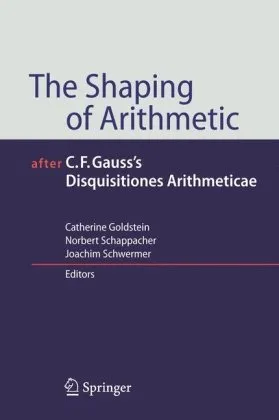
The Shaping of Arithmetic after C.F. Gauss's Disquisitiones Arithmeticae
Catherine Goldstein,Joachim Schwermer,Norbert Schappacher (Editors)
English
Beginner
Number Theory
4.5 / 5
0 reviews
2007
Published
579
pages
789
views
The Shaping of Arithmetic after C.F. Gauss's Disquisitiones Arithmeticae number theory evolution, mathematical history Explore The Shaping of Arithmetic after C.F. Gauss's Disquisitiones Arithmeticae and its impact on modern mathematical thought. Analytical Summary
Before you read
What will you get from this book?
Analytical Summary
The book The Shaping of Arithmetic after C.F. Gauss's Disquisitiones Arithmeticae offers a meticulous and scholarly examination of how Carl Friedrich Gauss’s seminal 1801 work, the Disquisitiones Arithmeticae, catalyzed profound developments in the field of number theory. Edited by Catherine Goldstein, Joachim Schwermer, and Norbert Schappacher, this volume brings together eminent historians and mathematicians to trace the trajectory of arithmetic from Gauss’s contributions to the rich complexity of modern mathematical discourse.
Serving as both a historical study and an intellectual bridge, the text delves into the multifaceted interpretations and extensions of Gauss’s ideas over more than two centuries. Chapters examine the original context of the Disquisitiones Arithmeticae, the mathematical methodologies Gauss pioneered, and the ways in which these concepts were integrated, expanded, and transformed by later generations of mathematicians. This analytical framework ensures that the reader gains a comprehensive understanding not only of Gauss’s work but also of its ongoing relevance within the history of mathematics.
A notable strength lies in the book’s ability to connect historical and technical perspectives, offering clear explanations of complex mathematical structures alongside narratives about the scholars who shaped arithmetic’s legacy. Readers with backgrounds in mathematics, philosophy of science, and historical research will appreciate the depth and precision, while those new to the topic will find it an authoritative introduction to the evolution of number theory.
Key Takeaways
This scholarly work highlights the enduring influence of Gauss’s groundbreaking approach to number theory and provides historical insight into the development of arithmetic as a mathematical discipline.
First, Gauss’s Disquisitiones Arithmeticae is presented not merely as a historical artifact, but as a living foundation upon which modern arithmetic has been constructed. Every chapter delineates specific contributions — such as modular arithmetic, quadratic reciprocity, and the theory of binary quadratic forms — and shows how these concepts evolved under the stewardship of later thinkers.
Second, the volume underscores the interplay between mathematical innovation and historical context. It reveals how external factors, including academic culture, institutional structures, and broader scientific trends, shaped the trajectory of arithmetic research.
Third, the editors provide a platform for diverse perspectives, ensuring a multi-voiced narrative that balances technical exposition with historical storytelling. This balanced approach enriches the reader’s grasp of the discipline’s evolution.
Memorable Quotes
"Every new truth discovered in mathematics illumines the whole structure in which Gauss laid the foundations." Unknown
"In tracing arithmetic’s lineage, we are tracing the intellectual DNA of modern mathematics." Unknown
"Gauss’s work is a perpetual source of questions — and of answers waiting to be found." Unknown
Why This Book Matters
For serious students, researchers, and academics, understanding the history and progression of arithmetic is more than a scholarly pursuit — it is a key to comprehending the very nature of mathematical thought.
This book situates Gauss’s contributions within a broad historical continuum, showing readers how foundational concepts were reinterpreted and extended in subsequent eras. It bridges the gap between historiography and mathematical analysis, offering content that is as rigorous in its historical documentation as it is in its technical accuracy.
By integrating historical narrative with mathematical insight, the editors and contributors create a resource that not only maps the evolution of number theory but also equips readers to apply this knowledge in contemporary contexts. From academic curricula to advanced research initiatives, the knowledge contained herein is invaluable.
Inspiring Conclusion
The Shaping of Arithmetic after C.F. Gauss's Disquisitiones Arithmeticae stands as a testament to the enduring nature of Gauss’s genius and the collaborative effort of scholars dedicated to charting arithmetic’s evolving landscape.
By reading this volume, you engage with the intellectual heritage that has defined number theory for over two centuries. The analytical rigor and historical breadth presented here make it an indispensable companion for anyone aiming to deepen their understanding of both the origins and modern applications of arithmetic. Whether you choose to discuss its ideas with peers, incorporate them into your research, or simply contemplate the lasting vision of Gauss, this work provides the foundation.
We invite you to read, share, and explore the insights contained in The Shaping of Arithmetic after
Ask this book
Your question is answered in the context of this title and author. Each answer uses 2 points.
Sign in to ask the book assistant.
Reader reviews
0 reviews, 4.5 average out of 5
No reviews yet
If you have read this book, help the next reader with your experience.
Write a review
Sign in to publish a review.
Reader questions and answers
Ask a focused question and learn from the community.
Sign in to ask or answer a question.
No questions yet
Be the first to ask a clear, useful question.
What to read next
Related references that continue this learning path.