
Book guide and evaluation
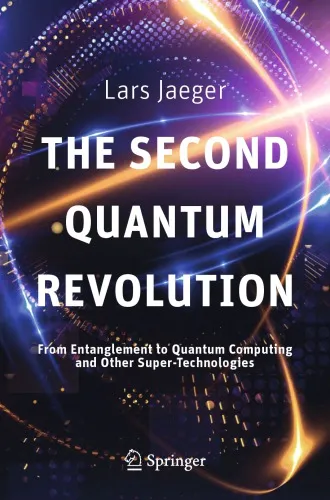
The Second Quantum Revolution: From Entanglement to Quantum Computing and Other Super-Technologies
Lars Jaeger
English
Beginner
Physics
4.6 / 5
0 reviews
2018
Published
331
pages
156
views
Introduction to "The Second Quantum Revolution: From Entanglement to Quantum Computing and Other Super-Technologies" The quantum realm once seemed like an enigmatic domain reserved only for physicists dwelling on abstract phenomena, far removed from everyday life. However, w
Before you read
What will you get from this book?
Introduction to "The Second Quantum Revolution: From Entanglement to Quantum Computing and Other Super-Technologies"
The quantum realm once seemed like an enigmatic domain reserved only for physicists dwelling on abstract phenomena, far removed from everyday life. However, with advancements in science and technology, we find ourselves at the precipice of an era where the principles of quantum mechanics are becoming integral to groundbreaking technologies. In "The Second Quantum Revolution: From Entanglement to Quantum Computing and Other Super-Technologies," Lars Jaeger delves deep into the fascinating world of quantum science and explores how it is transforming the way we think, innovate, and shape the future.
This book serves as a gateway for both the scientifically curious and technologically inclined to understand a revolution that promises to redefine modern civilization. In an age driven by data, speed, and efficiency, Jaeger unravels the mysteries of quantum entanglement, explains the startling advancements in quantum computing, and examines the sweeping possibilities of quantum technologies. He paints not only a comprehensive picture of what the next revolution in quantum science has to offer but also how these transformative technologies will impact society, industry, and even our understanding of reality itself.
Detailed Summary of the Book
The narrative of "The Second Quantum Revolution" begins by setting the stage for its subject. Lars Jaeger explains how the first quantum revolution of the early 20th century laid the theoretical and experimental foundations of quantum mechanics. This era witnessed remarkable innovations like lasers, transistors, and the atomic clock—technologies that still power much of modern life. Then, Jaeger transitions to what he terms the "second quantum revolution," where the focus shifts from discovering quantum phenomena to harnessing and exploiting them.
Jaeger intricately explains concepts such as quantum entanglement, superposition, and quantum tunneling, making them accessible to both novice and expert readers. He illustrates how these strange and often counterintuitive properties of quantum mechanics are now driving the development of new disruptive technologies—most notably, quantum computing. These computers will one day solve problems that are far beyond the capacity of classical computers, revolutionizing fields like cryptography, artificial intelligence, material science, and medicine.
In addition to quantum computing, Jaeger delves into the broader scope of quantum technologies including quantum communication, quantum sensing, and quantum simulation. These technologies will enable new methods of secure communication, highly sensitive measurements, and predictive models for complex systems. Recognizing both the potential and risks, the author also interrogates the philosophical and ethical implications of embracing quantum-powered systems.
With a narrative that intertwines historical milestones, scientific breakthroughs, and future aspirations, the book culminates with a discussion of humanity’s responsibilities in adopting such potent technologies. The second quantum revolution, Jaeger argues, has just begun, and its impact on economic, ethical, and philosophical paradigms will be monumental.
Key Takeaways
- The second quantum revolution moves beyond observation to application, fueling a new era of technological development.
- Quantum entanglement and superposition are no longer abstract concepts but practical tools enabling innovation in computation, communication, and more.
- Quantum computing has the potential to reshape industries by solving problems once deemed insurmountable for classical computers.
- The societal, economic, and philosophical consequences of quantum technologies are profound and call for careful consideration.
- Understanding quantum mechanics can empower readers to grasp the future of science and technology.
Famous Quotes from the Book
"Quantum mechanics is not just an esoteric theory; it is the language of the universe speaking to us in its most sensible form."
"In the unfolding quantum age, physics no longer just explains the world—it enables us to invent entirely new worlds."
Why This Book Matters
"The Second Quantum Revolution" is more than a scientific exploration; it is a timely and necessary read for anyone interested in the future of innovation and technology. Jaeger’s lucid explanations make complex quantum concepts understandable, further lowering the barrier for non-experts. At the same time, the book challenges readers to critically reflect on the broader implications of quantum technologies, urging society to think deeply about how we harness such power responsibly.
Moreover, quantum technologies are poised to become the backbone of modern infrastructure, just as classical technologies have shaped the digital revolution. Understanding the potential, challenges, and ethical complexities of this new quantum era is essential for thought leaders, policymakers, and innovators alike. Lars Jaeger’s book offers both a primer on the subject and a roadmap for navigating this uncharted terrain with wisdom and foresight.
Ultimately, "The Second Quantum Revolution" is a vital contribution to scientific literature that seeks to demystify quantum mechanics while inspiring its readers to engage with science, innovation, and a rapidly evolving world.
Ask this book
Your question is answered in the context of this title and author. Each answer uses 2 points.
Sign in to ask the book assistant.
Reader reviews
0 reviews, 4.6 average out of 5
No reviews yet
If you have read this book, help the next reader with your experience.
Write a review
Sign in to publish a review.
Reader questions and answers
Ask a focused question and learn from the community.
Sign in to ask or answer a question.
No questions yet
Be the first to ask a clear, useful question.
What to read next
Related references that continue this learning path.

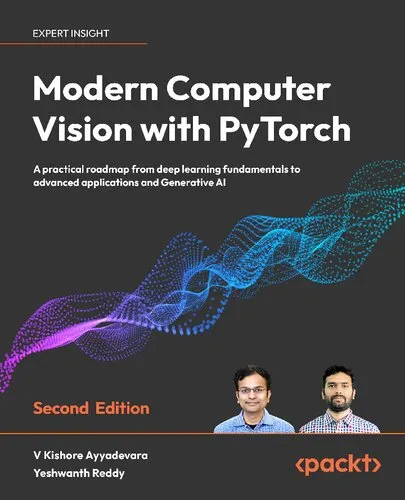
Modern Computer Vision with PyTorch: A Practical Roadmap From Deep Learning Fundamentals to Advanced Applications and Generative AI, 2nd Edition
V Kishore Ayyadevara,Yeshwanth Reddy
2023
View book