Building Better Minds: Artificial General Intelligence via the CogPrime Architecture
Ben Goertzel;Cassio Pennachin;Nil Geisweiller;OpenCog Team
2012
View book
Book guide and evaluation
Colin Renfrew,Chris Frith,Lambros Malafouris
0 reviews
Published
pages
views
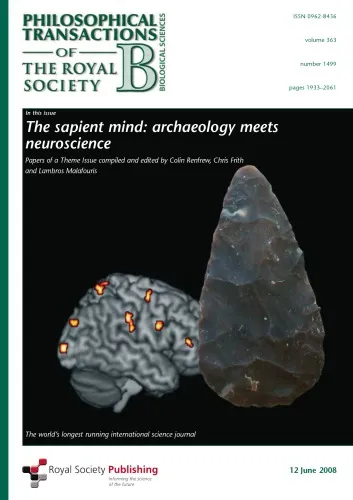
Introduction to The Sapient Mind: Archaeology Meets Neuroscience Welcome to an intriguing exploration into the depths of human cognition and its historical underpinnings. "The Sapient Mind: Archaeology Meets Neuroscience" provides a groundbreaking dialogue between two seemingl
Before you read
Welcome to an intriguing exploration into the depths of human cognition and its historical underpinnings. "The Sapient Mind: Archaeology Meets Neuroscience" provides a groundbreaking dialogue between two seemingly unrelated fields, unraveling the layers of the human mind through the intersection of archaeology and neuroscience. This collaboration sheds light on how our cognitive abilities have evolved over millennia and how this knowledge can inform our understanding of the present and future.
In "The Sapient Mind," Colin Renfrew, Chris Frith, and Lambros Malafouris orchestrate an interdisciplinary symphony that challenges the traditional boundaries between archaeology and neuroscience. Their work delves into how ancient artifacts are more than mere remnants of past cultures; they are keys to unlocking the cognitive processes of early humans. Through neuroscience, the book examines how our brain's structure and function have influenced cultural evolution and vice versa.
The collaboration reveals profound insights, such as how symbols and language acted as catalysts in the development of cognitive capabilities. The book presents case studies and methodologies that demonstrate how examining early human tools and artifacts can give clues to the cognitive processes behind their creation. It poses fundamental questions about consciousness and self-awareness, probing how our ancestors may have perceived their world and themselves.
"The essence of humanity lies not just in our biological evolution, but in the tools and symbols with which we have crafted our existence."
"To understand the mind, one must understand the world it has shaped and the legacy it carries."
The relevance of "The Sapient Mind" extends beyond academic curiosity; it holds significant implications for contemporary and future challenges. In a world where artificial intelligence is rapidly evolving, understanding the foundations of human thought is paramount. This book provides the cognitive archaeology framework for investigating the co-evolution of mind, culture, and technology.
By linking the past and the present, the authors offer a unique perspective on potential future developments and ethical considerations. This fusion of disciplines not only broadens the horizons of traditional archaeology and neuroscience but also delivers a reflective lens through which we can view the trajectory of human cognitive evolution.
Your question is answered in the context of this title and author. Each answer uses 2 points.
0 reviews, 4.3 average out of 5
Sign in to publish a review.
Ask a focused question and learn from the community.
Related references that continue this learning path.
Ben Goertzel;Cassio Pennachin;Nil Geisweiller;OpenCog Team