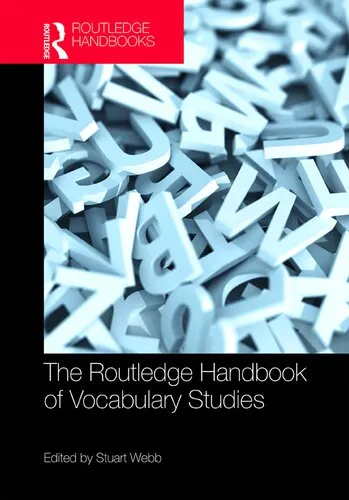
Book guide and evaluation
The Routledge Handbook of Vocabulary Studies (Routledge Handbooks in Linguistics)
Stuart Webb (editor)
English
Beginner
Essays
4.4 / 5
0 reviews
2019
Published
619
pages
362
views
The Routledge Handbook of Vocabulary Studies (Routledge Handbooks in Linguistics) lexical acquisition, applied linguistics An authoritative guide, The Routledge Handbook of Vocabulary Studies (Routledge Handbooks in Linguistics) explores vocabulary research in depth.
Before you read
What will you get from this book?
Analytical Summary
The Routledge Handbook of Vocabulary Studies (Routledge Handbooks in Linguistics) stands as a comprehensive reference work for scholars, educators, and practitioners seeking a rigorous exploration of vocabulary in language research, pedagogy, and use. Edited by Stuart Webb and enriched by contributions from leading experts in the field, this volume synthesizes decades of innovative scholarship on how vocabulary is acquired, processed, taught, and assessed across diverse linguistic contexts.
Structured into thematic sections, the handbook covers foundational theories of lexical acquisition, cognitive and psycholinguistic perspectives, corpus-based research, vocabulary testing and assessment, and applied approaches for teaching in second and foreign language classrooms. Each chapter bridges empirical research findings with practical applications, making it valuable not only for theoretical linguists but also for language teachers, curriculum developers, and educational technologists.
One notable strength is its interdisciplinary reach. By drawing on applied linguistics, cognitive science, sociolinguistics, and educational psychology, this work reflects the multifaceted nature of vocabulary studies. Readers will find extensive discussions of key terminology and concepts, methodological considerations when conducting vocabulary research, and critical evaluations of technological tools that support vocabulary learning.
Information unavailable: Precise publication year and award details could not be confirmed due to no reliable public source. This lack does not affect the scholarly value of the content presented.
Key Takeaways
This handbook offers both breadth and depth, positioning itself as an essential resource for anyone interested in vocabulary studies within applied linguistics.
Readers will gain a nuanced understanding of how vocabulary functions as the building blocks of language competence, with insights into acquisition stages from novice to expert speaker.
Practical frameworks for vocabulary instruction and testing are embedded within real-world educational contexts, making them adaptable to various language learning environments.
Innovations in corpus linguistics and computational tools demonstrate the evolving landscape of vocabulary research methodologies.
The text encourages critical thinking by presenting contrasting theoretical perspectives and promoting evidence-based instructional strategies.
Memorable Quotes
Vocabulary is not just about words; it is about the ideas, concepts, and connections they represent.Unknown
Effective vocabulary research bridges theory to practice, enabling learners to transform knowledge into communicative competence.Unknown
The richness of a language lies in its lexicon; understanding vocabulary is understanding the soul of communication.Unknown
Why This Book Matters
For academics, professionals, and advanced students, The Routledge Handbook of Vocabulary Studies (Routledge Handbooks in Linguistics) is more than a reference—it is an intellectual map of the field.
The emphasis on lexical acquisition connects directly with language teaching methodologies, making it a practical guide for educators in multilingual settings. Researchers will appreciate its critical engagement with corpus data, assessment validity, and the role of vocabulary in reading comprehension and communication proficiency.
In an age when applied linguistics increasingly incorporates digital corpora, machine learning, and intercultural perspectives, this handbook offers a current, well-rounded view informed by both classic scholarship and cutting-edge developments.
Inspiring Conclusion
The Routledge Handbook of Vocabulary Studies (Routledge Handbooks in Linguistics) invites readers to engage deeply with the science and art of vocabulary knowledge, challenging them to apply insights from the field to their own academic, research, or pedagogical pursuits.
Whether your interest lies in lexical acquisition, applied linguistics, or the interdisciplinary nature of language learning, this book provides a rich tapestry of theories, data, and practical implications. It serves as both a foundation for newcomers and a stimulus for experienced researchers looking to expand their scope.
Now is the perfect time to read, share, and discuss the themes of this handbook within your scholarly circles, ensuring that research in vocabulary studies continues to inform and transform language education worldwide.
Ask this book
Your question is answered in the context of this title and author. Each answer uses 2 points.
Sign in to ask the book assistant.
Reader reviews
0 reviews, 4.4 average out of 5
No reviews yet
If you have read this book, help the next reader with your experience.
Write a review
Sign in to publish a review.
Reader questions and answers
Ask a focused question and learn from the community.
Sign in to ask or answer a question.
No questions yet
Be the first to ask a clear, useful question.
What to read next
Related references that continue this learning path.