Book guide and evaluation
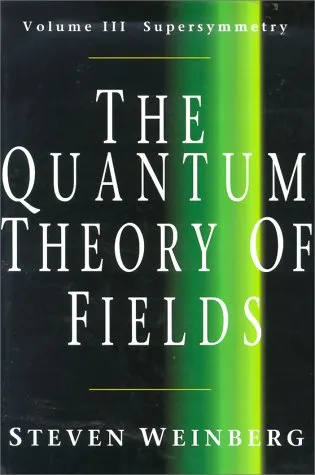
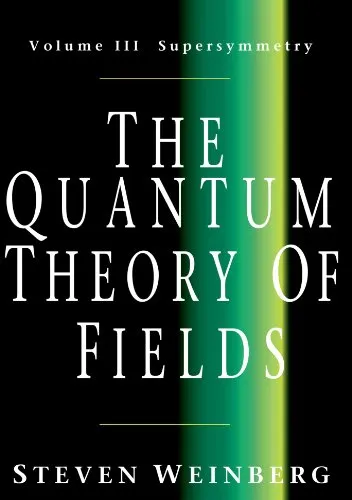
The Quantum Theory of Fields, Volume 3: Supersymmetry
Steven Weinberg
English
Beginner
Physics
4.5 / 5
0 reviews
2005
Published
443
pages
503
views
Introduction to "The Quantum Theory of Fields, Volume 3: Supersymmetry" Delve into the fascinating world of supersymmetry with "The Quantum Theory of Fields, Volume 3," a cornerstone in modern theoretical physics literature. In this volume, Steven Weinberg expands on the found
Before you read
What will you get from this book?
Introduction to "The Quantum Theory of Fields, Volume 3: Supersymmetry"
Delve into the fascinating world of supersymmetry with "The Quantum Theory of Fields, Volume 3," a cornerstone in modern theoretical physics literature. In this volume, Steven Weinberg expands on the foundational concepts introduced in the first two volumes and explores the profound implications of supersymmetry in field theory.
Detailed Summary
In "The Quantum Theory of Fields, Volume 3: Supersymmetry," Steven Weinberg meticulously constructs the framework of supersymmetry—an extension of the traditional symmetries in quantum field theory. The book is a comprehensive guide, starting with a basic understanding of graded Lie algebras and leading into complex discussions on supersymmetric models both in four dimensions and in higher dimensions. Weinberg examines how supersymmetry offers explanations for several unresolved problems in particle physics, such as the hierarchy problem and the unification of forces, while also proposing new avenues in the search for dark matter through particles like neutralinos.
The book is structured to serve both as a textbook for students learning the field and as a reference for seasoned physicists. It covers the technical formalism necessary for understanding supersymmetry, including superfields and superspace. Weinberg also discusses spontaneous symmetry breaking, non-perturbative effects, and the implications of supersymmetry in low-energy phenomenology as well as string theory.
Key Takeaways
- Supersymmetry is a theoretical framework that posits a symmetrical relationship between bosons and fermions. This symmetry helps address several issues in the Standard Model of particle physics.
- The book provides an in-depth analysis of mathematical concepts such as graded Lie algebras and their application to particle physics models.
- Supersymmetry predicts the existence of superpartners for every known particle, leading to discussions about potential candidates for dark matter.
- Weinberg's work emphasizes the use of supersymmetry as a tool to unify different forces and as a steppingstone towards a more comprehensive theory, such as supergravity or string theory.
Famous Quotes from the Book
"Supersymmetry, if it exists in nature, is not a symmetry of the equations, but of the solutions."
"The allure of supersymmetry is not just that it provides a large repository of potential new particles but that it suggests that our views of space-time and matter are incomplete."
Why This Book Matters
"The Quantum Theory of Fields, Volume 3: Supersymmetry" is pivotal for several reasons. In the ever-evolving landscape of theoretical physics, the concept of supersymmetry remains one of the most promising leads for a more unified theory. This book is crucial for those seeking to understand the prospective advances in particle physics and cosmology. Weinberg's work serves as a bridge between traditional field theories and the burgeoning research into supersymmetric models.
The volume's educational design makes it accessible to those aiming to grasp the sophisticated mathematical rigor of supersymmetry without sacrificing depth. It acts as both a scholarly repository and a beacon of inspiration for future research, compelling readers to ponder the vast potential that lies beyond current scientific paradigms.
In sum, this book not only reiterates Weinberg's profound impact on the quantum theory of fields but also pushes the boundaries of what is known about the universe's fundamental components, motivating both theoretical advancements and experimental pursuits.
Ask this book
Your question is answered in the context of this title and author. Each answer uses 2 points.
Sign in to ask the book assistant.
Reader reviews
0 reviews, 4.5 average out of 5
No reviews yet
If you have read this book, help the next reader with your experience.
Write a review
Sign in to publish a review.
Reader questions and answers
Ask a focused question and learn from the community.
Sign in to ask or answer a question.
No questions yet
Be the first to ask a clear, useful question.
What to read next
Related references that continue this learning path.
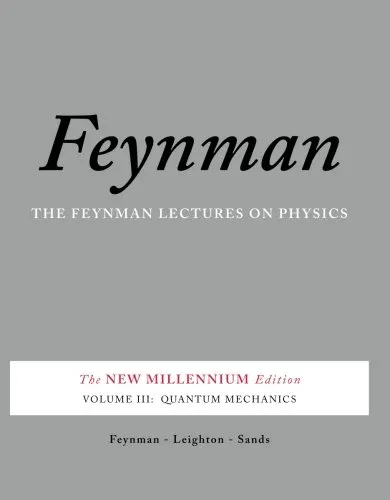
The Feynman Lectures on Physics, Vol. III: The New Millennium Edition: Quantum Mechanics
Richard P. Feynman,Robert B. Leighton,Matthew Sands
2011
View book