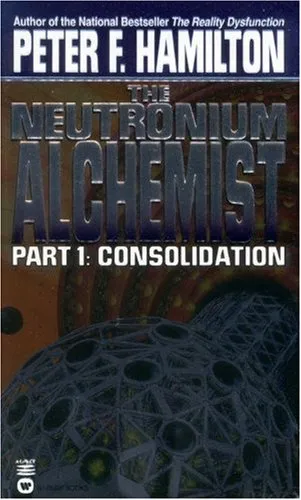
The Neutronium Alchemist: Part I - Consolidation (Neutronium Alchemist)
Peter F. Hamilton
1998
View book
Book guide and evaluation
Erich W. Schmid, Horst ZiegelmannandH. Stumpf (Auth.)
0 reviews
Published
pages
views
The exploration of the quantum mechanical three-body problem represents a fundamental frontier in theoretical physics, bridging the realms of both quantum mechanics and classical dynamics. In our book, "The Quantum Mechanical Three-Body Problem," we delve into this complex ye
Before you read
The exploration of the quantum mechanical three-body problem represents a fundamental frontier in theoretical physics, bridging the realms of both quantum mechanics and classical dynamics. In our book, "The Quantum Mechanical Three-Body Problem," we delve into this complex yet fascinating subject, providing insights and comprehensive analyses aimed at both seasoned physicists and advanced students. This book is part of the prestigious Vieweg Tracts in Pure and Applied Physics series and stands out for its rigorous approach and clarity of presentation.
The book begins with an introduction to the historical context and significance of the three-body problem within quantum mechanics. This classical issue, first encountered in celestial mechanics, finds a new and challenging form in quantum systems. The complexities arise from the interactions between three distinct particles, where the solutions cannot be generalized simply from two-body systems.
We approach the problem by developing the mathematical formulation of the three-body Schrödinger equation, exploring both exact and approximate methods for finding solutions. The text meticulously discusses the use of various coordinate systems, including Jacobi and hyperspherical coordinates, each providing unique advantages in solving these problems.
The middle sections of the book present various analytic and numerical techniques, including perturbation methods, variational principles, and wave function expansions. We emphasize their applications in practical problems, such as helium-like ions and nuclear physics scenarios, demonstrating the breadth and depth of three-body challenges in quantum mechanics.
Our concluding chapters reflect on recent advancements and potential future directions in the study of three-body systems. We discuss open questions and frontier research areas, inviting the reader to consider the impacts of our findings on broader fields like condensed matter physics, atomic collisions, and quantum chemistry.
“The three-body problem is not simply a challenge of physical understanding but a crucible in which the capabilities of quantum mechanics are tested and extended.”
“In the realm of quantum mechanics, three is not merely a number, but a symbol of complexity, interaction, and the limits of knowledge.”
Our book is pivotal for those engaged in the study of theoretical physics, offering a thorough explanation of a complex quantum problem that remains a topic of active research today. The coverage of analytical techniques and problem-solving strategies is designed to equip readers with the skills necessary to advance their own research and comprehension of quantum mechanics.
Moreover, by connecting historical context with contemporary applications, the book serves as a vital resource for connecting foundational theory with cutting-edge research. The inclusion of numerous examples and practical applications helps bridge the gap between theoretical underpinnings and real-world phenomena, making the book invaluable for physicists aiming to push the boundaries of their fields.
Your question is answered in the context of this title and author. Each answer uses 2 points.
0 reviews, 4.6 average out of 5
Sign in to publish a review.
Ask a focused question and learn from the community.
Related references that continue this learning path.
Peter F. Hamilton