Trendology: Building an Advantage through Data-Driven Real-Time Marketing
Chris Kerns (auth.)
2014
View book
Book guide and evaluation
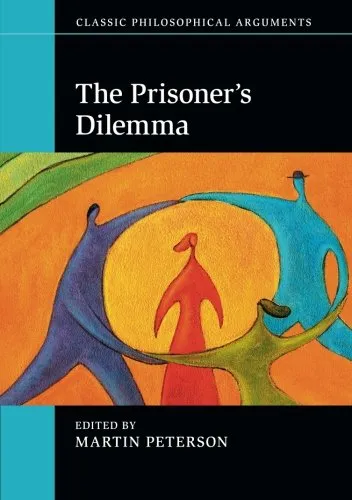
Martin Peterson
0 reviews
Published
pages
views
Introduction to "The Prisoner’s Dilemma" "The Prisoner’s Dilemma" is an exploration of one of the most compelling concepts in game theory and how it applies to critical decisions in our lives, society, and global systems. Written by Martin Peterson, this book delves into the p
Before you read
"The Prisoner’s Dilemma" is an exploration of one of the most compelling concepts in game theory and how it applies to critical decisions in our lives, society, and global systems. Written by Martin Peterson, this book delves into the philosophical, psychological, and mathematical dimensions of decision-making, weaving the story of cooperation and conflict in a way that’s accessible to readers from all walks of life. Through real-world examples, theoretical investigation, and practical applications, the book challenges you to rethink how we interact with one another in a competitive and interdependent world.
"The Prisoner’s Dilemma" revolves around the famous theoretical scenario in game theory that describes how individuals might not cooperate, even if it’s in their best interest to do so. The book begins by introducing the basic premise: two prisoners are caught and interrogated separately. If both prisoners cooperate (stay silent), they will receive a lighter punishment. However, if one betrays the other, he walks free while the other gets a harsh penalty. If both betray, they both receive moderate punishment. This deceptively simple scenario opens the door to a deeper philosophical inquiry into human behavior.
The book goes on to explain the broader implications of the prisoner’s dilemma in areas ranging from economics to politics, environmental challenges, and personal relationships. By using engaging historical examples and modern case studies, the narrative ties abstract theories to everyday decision-making. Whether it’s global nuclear disarmament or deciding whether to split or steal on a game show, the principles of the prisoner’s dilemma resonate throughout our lives.
Moreover, the book explores variations of the dilemma, such as iterated and multiplayer versions, and introduces strategies like "Tit-for-Tat" and "Always Defect." Each chapter builds on key concepts, making the content engaging and informative, whether you’re a game theory novice or an expert.
“In the absence of trust, suspicion thrives; in the presence of trust, collaboration flourishes.”
“The prisoner’s dilemma is more than a thought experiment; it’s a mirror that reflects the inner workings of our social fabric.”
“Decision-making is an art and science, and game theory teaches us to blend logic with empathy.”
"The Prisoner’s Dilemma" matters because it addresses one of the most enduring challenges of human existence: how to balance individual needs and collective goals. The book’s insights extend far beyond academic theories, influencing disciplines like ethics, economics, politics, psychology, and sociology. By understanding the dynamics of cooperation and competition, readers gain tools to navigate complex real-world challenges, from resolving workplace disputes to fostering international peace.
Furthermore, the book emphasizes the importance of trust, communication, and empathy in developing solutions to the prisoner’s dilemma. These principles are not merely abstract ideals but practical guidelines for improving relationships and building a more cooperative society. "The Prisoner’s Dilemma" serves as both a thought-provoking academic inquiry and a practical guide to better decision-making in our interconnected world.
Your question is answered in the context of this title and author. Each answer uses 2 points.
0 reviews, 4.9 average out of 5
Sign in to publish a review.
Ask a focused question and learn from the community.
Related references that continue this learning path.
Chris Kerns (auth.)
Neumeier,Marty