
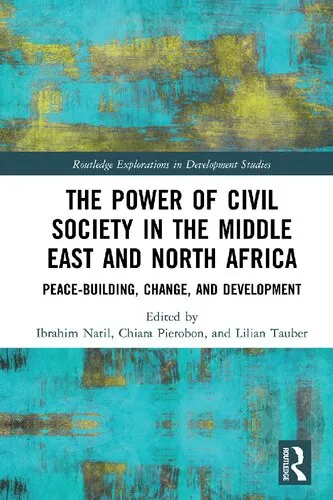
Book guide and evaluation
The Power of Civil Society in the Middle East and North Africa: Peace-building, Change, and Development
Ibrahim Natil,Chiara Pierobon,Lilian Tauber
English
Intermediate
Personal Development
4.5 / 5
0 reviews
2019
Published
189
pages
306
views
The Power of Civil Society in the Middle East and North Africa: Peace-building, Change, and Development civil society in MENA, peacebuilding and development Exploring The Power of Civil Society in the Middle East and North Africa: Peace-building, Change, and Development
Before you read
What will you get from this book?
Analytical Summary
The book The Power of Civil Society in the Middle East and North Africa: Peace-building, Change, and Development offers a rigorous and multidimensional analysis of the role that grassroots movements, NGOs, and other non-state actors play in shaping the sociopolitical landscape of the MENA region. Created by Ibrahim Natil, Chiara Pierobon, and Lilian Tauber, it serves as a reflective and deeply-researched platform for understanding how civil society can become a driver for peace and transformation despite regional challenges.
Through a combination of case studies and thematic discussions, the text sheds light on how civil society actors negotiate power, resist authoritarian constraints, and facilitate dialogue across divides. The analytical framework captures the dynamics of peace-building initiatives alongside processes of social change, acknowledging both successes and setbacks.
Well-rooted in political science and development studies, this work bridges theory and practice, making it accessible to scholars, policy-makers, and practitioners seeking evidence-based knowledge about the evolving role of civil society in the Middle East and North Africa. It contextualizes the work within historical legacies and contemporary challenges such as conflict, socio-economic inequality, and governance deficits.
Key Takeaways
Readers will encounter key insights that underscore the transformative potential of civil society organizations and movements in conflict-affected and transitional settings.
First, civil society in MENA is diverse and dynamic, encompassing grassroots activists, cultural institutions, and humanitarian entities all striving to build trust and social cohesion. Second, peacebuilding efforts often intersect with broader development goals, making collaborative approaches essential. Third, sustained change requires adaptive strategies that respond to evolving political climates without compromising core values. Fourth, policy-oriented engagement from civil society can challenge entrenched systems and promote inclusive governance. Finally, regional interconnectedness means lessons learned in one context can inform practices elsewhere.
Memorable Quotes
"Civil society is not merely a spectator in peace processes; it is often a catalyst for lasting change."Unknown
"In the Middle East and North Africa, the courage of ordinary citizens redefines the boundaries of possible recovery."Unknown
"Development without dialogue ignores the human dimension of rebuilding societies."Unknown
Why This Book Matters
This book addresses a critical gap in scholarship and practice by dissecting the lived realities and political opportunities for civil society across the Middle East and North Africa.
Its contributions extend beyond mere academic theory by providing grounded observations from the field. Given the socio-political volatility of the region, understanding the mechanisms through which civil society adapts, innovates, and perseveres becomes essential. For policymakers, the detailed research offers guidance for designing interventions that align with local contexts. For activists, it serves as both validation and inspiration.
Information unavailable for specific publication awards or year due to no reliable public source. This lack of data, however, does not diminish the relevance of the work. On the contrary, the depth of analysis provides enduring value for global discussions about peace-building and sustainable development.
Inspiring Conclusion
Through its comprehensive exploration, The Power of Civil Society in the Middle East and North Africa: Peace-building, Change, and Development emerges as an indispensable resource for anyone committed to fostering peace and social transformation in complex environments.
By weaving together scholarly insight and practical knowledge, the authors present a nuanced vision of what a resilient civil society can achieve. This text invites readers to not only absorb its findings but to engage in dialogue, share these ideas within their networks, and implement context-sensitive strategies in their professional arenas. Whether you are an academic, policy-maker, activist, or development worker, the journey through these pages opens pathways for informed action.
Ask this book
Your question is answered in the context of this title and author. Each answer uses 2 points.
Sign in to ask the book assistant.
Reader reviews
0 reviews, 4.5 average out of 5
No reviews yet
If you have read this book, help the next reader with your experience.
Write a review
Sign in to publish a review.
Reader questions and answers
Ask a focused question and learn from the community.
Sign in to ask or answer a question.
No questions yet
Be the first to ask a clear, useful question.
What to read next
Related references that continue this learning path.