

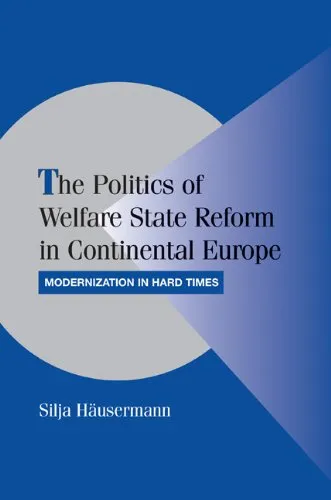
Book guide and evaluation
The Politics of Welfare State Reform in Continental Europe: Modernization in Hard Times
Silja Hausermann
English
Intermediate
novel
4.0 / 5
0 reviews
2010
Published
300
pages
409
views
Welcome to an insightful exploration of the intricate dynamics of welfare state reform in Continental Europe. 'The Politics of Welfare State Reform in Continental Europe: Modernization in Hard Times' delves deep into the multifaceted political, social, and economic forces that
Before you read
What will you get from this book?
Welcome to an insightful exploration of the intricate dynamics of welfare state reform in Continental Europe. 'The Politics of Welfare State Reform in Continental Europe: Modernization in Hard Times' delves deep into the multifaceted political, social, and economic forces that shape the evolution of welfare policies amidst challenging circumstances. This book offers an essential understanding of how modernization processes impact welfare states and the political economies of European countries.
Detailed Summary of the Book
The book provides a comprehensive analysis of the political mechanisms driving welfare state reforms in Continental Europe. The journey begins by addressing the contextual framework—highlighting the historical background and the fundamental elements intrinsic to welfare states within this region. With a focus on modernization, the book dissects how countries adapt to changing economic and demographic pressures.
Silja Hausermann argues that welfare state reform is invariably politicized, with varying outcomes across different countries due to unique institutional arrangements and political configurations. The book uses comparative case studies from countries such as Germany, France, and Italy, presenting a nuanced understanding of how political actors negotiate and implement welfare policies in response to contemporary challenges.
Through meticulous research, the book unpacks the role of political strategies, public opinion, and institutional legacies in shaping welfare state adaptations. It also addresses how external pressures, such as economic globalization and European integration, are managed by national policymakers. The exploration situates the debate of welfare reform within the broader theme of maintaining social solidarity in an era of constrained public resources.
Key Takeaways
- The relationship between political institutions and welfare state reform is complex and requires an understanding of both external forces and domestic politics.
- Welfare state reform is deeply influenced by partisan politics, with different parties prioritizing distinct aspects of welfare policies.
- Modernization processes involve managing the dual pressures of fiscal austerity and the need to sustain comprehensive social protections.
- Historical path dependencies significantly impact the capacity for reform within different national contexts.
- Understanding the interplay of national and supranational pressures is crucial for comprehending the evolution of welfare policies.
Famous Quotes from the Book
“Modernization in the realm of welfare state reform cannot be divorced from its political dimensions, as it reflects the contours of ideological and institutional battles.”
“In an era of globalization and Europeanization, national welfare states are both constrained and liberated, prompting varied responses to similar challenges.”
Why This Book Matters
'The Politics of Welfare State Reform in Continental Europe: Modernization in Hard Times' is a critical contribution to understanding the evolving nature of social protection systems in the 21st century. It matters because it sheds light on the complex interplay of economic forces, political dynamics, and social imperatives that shape welfare policy outcomes. By illuminating how different countries navigate similar challenges, the book provides readers with a broader perspective on potential paths for managing welfare state reforms effectively.
For scholars, policymakers, and anyone interested in European politics or social policy, this book offers both a rich empirical account and a theoretical framework for analyzing welfare state changes. Its relevance extends beyond academic interest, serving as a guide for designing more resilient and inclusive social policies amidst modern-day adversities.
Ask this book
Your question is answered in the context of this title and author. Each answer uses 2 points.
Sign in to ask the book assistant.
Reader reviews
0 reviews, 4.0 average out of 5
No reviews yet
If you have read this book, help the next reader with your experience.
Write a review
Sign in to publish a review.
Reader questions and answers
Ask a focused question and learn from the community.
Sign in to ask or answer a question.
No questions yet
Be the first to ask a clear, useful question.
What to read next
Related references that continue this learning path.


Jesus and John Wayne: How White Evangelicals Corrupted a Faith and Fractured a Nation
Kristin Kobes Du Mez
2020
View book

The Oxford Handbook of the International Relations of Asia
Saadia M. Pekkanen,John Ravenhill,Rosemary Foot
2014
View book