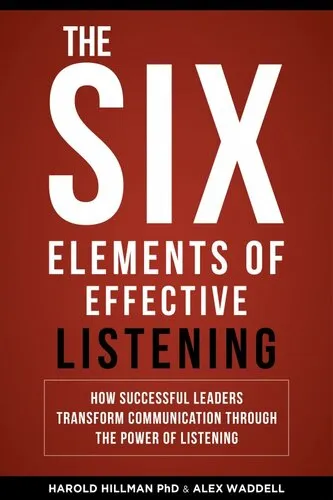
The Six Elements of Effective Listening: How Successful Leaders Transform Communication Through the Power of Listening
Harold Hillman;Alex Waddell
2016
View book
Book guide and evaluation
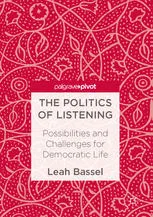
Leah Bassel (auth.)
0 reviews
Published
pages
views
Welcome to an exploration of 'The Politics of Listening: Possibilities and Challenges for Democratic Life,' a pivotal book that unveils the intricate fabric of listening within a democratic context. Authored by Leah Bassel, the book digs deep into the dynamics of voice and atte
Before you read
Welcome to an exploration of 'The Politics of Listening: Possibilities and Challenges for Democratic Life,' a pivotal book that unveils the intricate fabric of listening within a democratic context. Authored by Leah Bassel, the book digs deep into the dynamics of voice and attention, seeking to unravel how power and privilege influence who gets heard and who remains ignored in our society.
In 'The Politics of Listening,' Leah Bassel embarks on an incisive journey through the political landscape, spotlighting the essential yet often overlooked act of listening. The book challenges the traditional understanding of democratic participation, which usually emphasizes speaking and expression. Instead, Bassel posits that listening is a profoundly political act that is central to the health and functioning of democratic life.
The book dissects how voices in society are differentially attended to, with a focus on marginalized groups often silenced by systems of power. Bassel examines the mechanisms through which certain voices are ignored and the implications this has for democratic engagement. The text is woven with case studies and theoretical insights, drawing from diverse fields such as feminist theory, critical race studies, and political theory, to illustrate how listening is mobilized politically.
Bassel's work is a call to revalue listening, suggesting that by attending to what is often unheard, societies can move toward more inclusive and equitable forms of democracy. The book builds a compelling argument for why listening should be seen not merely as a passive act but as an active, potent force for political change.
"Listening is not just about being there when someone talks; it's about engaging with the unheard."
"In the cacophony of democratic discourse, marginalized voices are silenced not by the absence of speech, but by the absence of listening."
"The politics of listening requires that we reevaluate our priorities and recognize the powerful impact of attending to the ignored."
In a world where polarizing voices dominate public discourse, Bassel's 'The Politics of Listening' serves as a timely reminder of the power dynamics inherent in communication. As democratic societies grapple with issues of representation and equity, this book emphasizes the necessity of cultivating a culture of listening. Recognizing that certain voices are systematically marginalized, the book calls for an active restructuring of how we engage with others in the democratic process. Its insights are crucial for policymakers, activists, and citizens committed to fostering more inclusive and fair democratic practices.
By highlighting the politics of listening, Bassel provides a critical tool for understanding and addressing the barriers to genuine democratic participation. The book compels readers to consider their roles not only as speakers but as attentive listeners in the ongoing effort to achieve social justice.
Your question is answered in the context of this title and author. Each answer uses 2 points.
0 reviews, 4.7 average out of 5
Sign in to publish a review.
Ask a focused question and learn from the community.
Related references that continue this learning path.
Harold Hillman;Alex Waddell
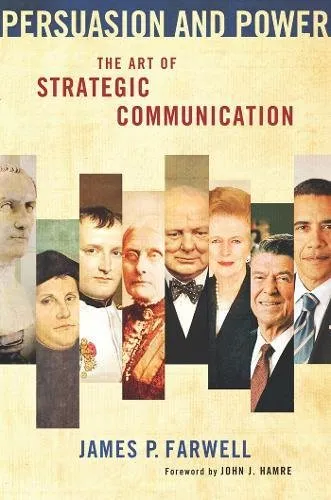
James P. Farwell,John J. Hamre