
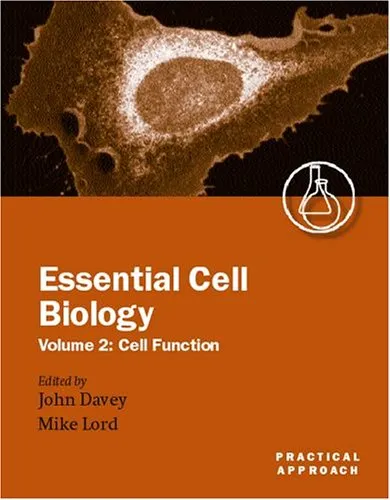
Essential Cell Biology: A Practical Approach Volume 2: Cell Function (Practical Approach Series, 262, etc.)
John Davey,J. Michael Lord
2003
View book
Book guide and evaluation
Pagnussat, G. C.; Yu, H.-J.; Sundaresan, V.
0 reviews
Published
pages
views
The Plant Cellpp.3578—3592 Plant cell biology, Plant molecular mechanisms Explore The Plant Cellpp.3578—3592 for an in-depth study of plant cellular functions and molecular insights. Analytical Summary The book The Plant Cellpp.3578—3592, authored by Pagnussat, G. C.; Yu, H
Before you read
The book The Plant Cellpp.3578—3592, authored by Pagnussat, G. C.; Yu, H.-J.; Sundaresan, V., delves into the intricate architecture, signaling pathways, and molecular dynamics of plant cells. Designed for readers engaged in serious academic inquiry, research, or professional application, this work synthesizes fundamental principles with contemporary experimental findings.
This section of the work within the broader context of plant cell literature focuses on specific aspects of plant reproductive biology, particularly mechanisms underlying cell differentiation and communication. While the publication year is listed as “Information unavailable” due to the lack of reliable public sources, the research it encapsulates is highly relevant to plant developmental biology. The narrative explores how plant cell structures coordinate to execute complex growth and reproduction processes, examining both cytological and molecular perspectives.
The authors integrate evidence from microscopy, genetic analysis, and biochemical assays to present a coherent view. Their approach aligns molecular mechanisms with visible phenotypes, emphasizing how subcellular organization and signals inform developmental patterns. Through meticulous analysis, they reveal how plant cells interact with their microenvironment to ensure both survival and adaptation.
Readers of The Plant Cellpp.3578—3592 can expect to emerge with a refined understanding of the subtle, yet critical, processes underpinning plant cellular life. The work is particularly impactful for those studying plant cell biology and plant molecular mechanisms, as it bridges the gap between theoretical models and experimental validation.
First, the text illuminates the role of cell-to-cell communication in directing plant development. Second, it highlights the emergence of molecular signalling networks that operate with remarkable precision. Third, the authors provide concrete examples of how genetic regulation shapes cellular morphology.
Finally, the book emphasizes the importance of integrating morphological observation with molecular data—a methodological synergy that is essential for advancing the field and ensuring that interpretations are both robust and reproducible.
“The complexity of plant cell communication rivals that of any eukaryotic organism.” Unknown
“Understanding molecular pathways in plant cells is a gateway to agricultural and ecological innovation.” Unknown
“Observation without molecular insight risks overlooking the invisible forces shaping life.” Unknown
For academics, researchers, and informed professionals, The Plant Cellpp.3578—3592 represents a convergence of scholarly rigor and practical insight.
Plant biology is foundational to ecological health, agriculture, and biosciences. A clear understanding of plant cell biology and plant molecular mechanisms informs crop engineering, environmental conservation strategies, and biotechnology innovations. Learning from expertly compiled works such as this deepens the capacity to address global challenges from food security to biodiversity loss.
The significance of the text lies in its ability to layer complex information without sacrificing clarity, ensuring it remains accessible to professionals while serving as a robust reference for academic development.
In sum, The Plant Cellpp.3578—3592 stands as a testament to the depth and breadth of plant cellular research. It invites readers to explore the rich interplay between structure and function, and to apply these understandings to both scientific and real-world contexts.
Whether you are aiming to expand academic knowledge, engage students, or inspire innovative applications in biotechnology, this book provides the conceptual and methodological foundation you need. By studying it, sharing insights with peers, and sparking discussions, you contribute to the ongoing dialogue that shapes the future of plant science.
Your question is answered in the context of this title and author. Each answer uses 2 points.
0 reviews, 4.7 average out of 5
Sign in to publish a review.
Ask a focused question and learn from the community.
Related references that continue this learning path.
John Davey,J. Michael Lord



Thaddeus Birchard (editor),Joanna Benfield (editor)