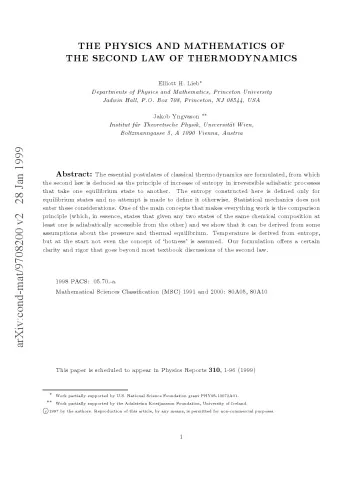
Introduction to "The Physics and Mathematics of the Second Law of Thermodynamics"
The book "The Physics and Mathematics of the Second Law of Thermodynamics" by Elliott H. Lieb and Jakob Yngvason provides a comprehensive exploration of one of the most profound principles of physics. Through meticulous mathematical analysis and insightful physical interpretation, the authors elucidate the complexities and nuances of the Second Law, making it accessible to both seasoned scientists and enthusiastic learners.
Detailed Summary of the Book
The Second Law of Thermodynamics is a cornerstone of physics that dictates the direction in which processes occur in nature. This book meticulously explores its foundation, exploring both classic and contemporary interpretations. Starting with historical perspectives, the authors guide readers through the evolution of thermodynamics, ultimately leading up to modern applications that underscore the law's universal relevance.
The work is divided into sections that detail the law’s mathematical framework and its physical implications. Not only does it delve into classical thermodynamics, but it also touches upon statistical mechanics and quantum physics, illustrating how the Second Law manifests across different scales of nature. Comprehensive examples and theoretical exercises help cement the reader’s understanding by bridging theoretical insights with tangible applications.
Key Takeaways
- Understanding the historical context and scientific necessity of the Second Law.
- Grasping the mathematical rigor behind concepts like entropy, temperature, and energy conversion.
- Recognizing the Second Law's influence on both microscopic and macroscopic phenomena.
- Appreciating the universal applicability across various fields such as chemistry, biology, and cosmology.
- Identifying the philosophical implications of the law's irreversibility.
Famous Quotes from the Book
"The Second Law is not just a law of physics, but a principle that governs the very fabric of reality."
"Entropy can be understood as the arrow of time, pointing in the direction of irreversible processes."
Why This Book Matters
In a world increasingly reliant on scientific understanding, grasping the Second Law of Thermodynamics is akin to possessing a master key to natural processes. This book is paramount because it does not just teach about a physical law; it enables readers to think critically about energy, systems, and the profound interconnectedness of the universe.
By demystifying the Second Law through a dual lens of physics and mathematics, readers are equipped to apply these principles across numerous scientific disciplines, from engineering and environmental science to emerging fields in technology and quantum mechanics. The authors' clear exposition and dedication to teaching make this text an invaluable resource for both academic study and personal enrichment.
Ultimately, "The Physics and Mathematics of the Second Law of Thermodynamics" is more than a guide—it's a beacon of knowledge illuminating the path toward understanding one of the natural world's most enduring truths.