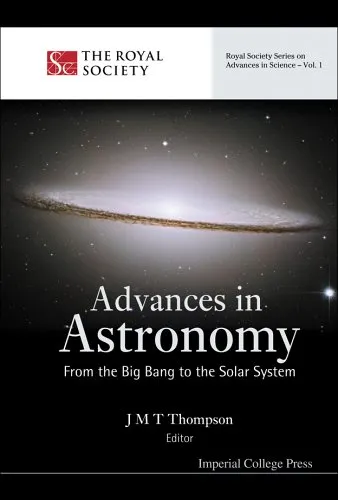
Advances in Astronomy: From the Big Bang to the Solar System (2005)(en)(417s)
J. M. T. Thompson
2005
View book

Book guide and evaluation
John D Barrow (auth.),John D. Barrow,Alfredo B. Henriques,Maria Teresa V. T. Lago,Malcolm S. Longair (eds.)
0 reviews
Published
pages
views
Introduction to "The Physical Universe: The Interface Between Cosmology, Astrophysics and Particle Physics" Spanning the frontiers of contemporary scientific exploration, "The Physical Universe" delves into the intricate connections between cosmology, astrophysics, and parti
Before you read
Spanning the frontiers of contemporary scientific exploration, "The Physical Universe" delves into the intricate connections between cosmology, astrophysics, and particle physics. Captured within the proceedings of the XII Autumn School of Physics held in Lisbon, Portugal from 1-5 October 1990, this book serves as a crucial compendium for scholars, researchers, and enthusiasts of the physical sciences. As edited by John D. Barrow and others, this volume presents a comprehensive investigation into the fundamental questions concerning the nature of the universe and the very laws of physics that govern it.
The book encapsulates a series of insightful lectures from prominent scientists who examine how the universe behaves on grand scales while also probing into the minute aspects that lie beneath the quantum threshold. By paying particular attention to the interplay between macroscopic and microscopic processes, these proceedings offer a multifaceted view of the universe. The discourse encompasses a variety of topics including the origins of the universe, the evolution and composition of galaxies, and the relentless search for a unified theory that can effectively weave together the force of gravity with quantum mechanics. Despite the inherent complexity of the subject matter, the text remains accessible, making it a seminal work for those interested in the confluence of astrophysical phenomena and particle physics.
"The universe is not just a collection of its parts but a complex entity whose laws and interactions continue to elude our greatest minds."
"To comprehend the vastness of the universe, we must first delve into the dynamics of its most fundamental constituents."
"The search for a unified theory is not merely a quest for knowledge, but a journey towards understanding our place in the cosmos."
As scientific boundaries continue to blur, "The Physical Universe" stands out as a key resource that bridges various academic disciplines. By highlighting groundbreaking research and fostering multidisciplinary discussions, this book has laid the groundwork for future studies in cosmology, astrophysics, and particle physics. Its role in educating and inspiring a new generation of scientists cannot be understated. At a time when our understanding of the universe grows increasingly complex, the insights presented in this book remind us of the importance of collaboration and continuing to ask the fundamental questions.
Moreover, as we find ourselves in an era where technological advancements offer unprecedented opportunities to observe and understand the universe, the theoretical frameworks and observations detailed within these pages become even more relevant. They serve as a beacon guiding current and future research endeavors as we continue to unravel the cosmic mysteries that have intrigued humankind for millennia.
Your question is answered in the context of this title and author. Each answer uses 2 points.
0 reviews, 4.4 average out of 5
Sign in to publish a review.
Ask a focused question and learn from the community.
Related references that continue this learning path.
J. M. T. Thompson