Lectures on Quantum Mechanics: With Problems, Exercises and their Solutions
Jean-Louis Basdevant
2016
View book
Book guide and evaluation
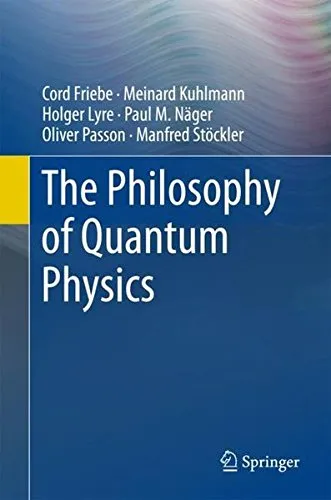
Cord Friebe,Meinard Kuhlmann,Holger Lyre,Paul M. Näger,Oliver Passon,Manfred Stöckler
0 reviews
Published
pages
views
Welcome to the introduction of 'The Philosophy of Quantum Physics', a comprehensive book that delves deep into the intriguing and often mysterious connection between philosophy and quantum mechanics. Co-written by Cord Friebe, Meinard Kuhlmann, Holger Lyre, Paul M. Näger, O
Before you read
Welcome to the introduction of 'The Philosophy of Quantum Physics', a comprehensive book that delves deep into the intriguing and often mysterious connection between philosophy and quantum mechanics. Co-written by Cord Friebe, Meinard Kuhlmann, Holger Lyre, Paul M. Näger, Oliver Passon, and Manfred Stöckler, this work seeks to bridge the gap between the interpretative puzzles of quantum mechanics and the philosophical inquiry that these enigmas inspire. Designed for philosophers, physicists, and curious readers, this book offers a thought-provoking exploration into one of the most fascinating areas of contemporary science and philosophy.
'The Philosophy of Quantum Physics' presents a detailed examination of the fundamental questions raised by quantum theory and its philosophical implications. Quantum mechanics, a scientifically rigorous field, challenges classical notions of reality, causality, and observation, leading to paradigms that question the nature of existence itself. This book skillfully navigates these theoretical landscapes by discussing key quantum principles such as wave-particle duality, superposition, entanglement, and non-locality, while exploring how such principles reshape our conceptual understanding of nature.
A major focus of the book is on interpreting quantum mechanics. From the Copenhagen interpretation and Many-Worlds theory to relational quantum mechanics and QBism, each framework is analyzed not only for its explanatory power but also for the philosophical ramifications it entails. The co-authors address questions like: Is the quantum world deterministic or probabilistic? Does reality exist independently of observation? What role does consciousness play in shaping the physical universe? Through careful argumentation and illustrative examples, the authors invite readers to critically reflect on these profound issues.
Furthermore, this work emphasizes the interplay between scientific advancement and philosophical thought. As the authors argue, quantum mechanics represents more than a mere scientific revolution; it challenges entrenched metaphysical ideas and demands new ways of thinking about knowledge, reality, and existence—making the collaboration between physicists and philosophers essential for understanding its deeper meaning.
"Quantum mechanics does not only describe the behavior of particles at the microscopic level; it challenges our deepest assumptions about the nature of existence and our role as observers."
"Reality, as suggested by quantum mechanics, is far from being an objective, static entity; it is a dynamic interplay of possibilities, actualities, and observations."
'The Philosophy of Quantum Physics' holds significant relevance for both contemporary science and philosophy. As one of the most successful theories in physics, quantum mechanics has transformed technology, enabling advancements such as semiconductors, lasers, and quantum computing. At the same time, it has confronted us with profound conceptual and philosophical challenges that traditional thinking cannot fully address.
The book’s interdisciplinary approach highlights the necessity of combining scientific expertise with philosophical inquiry to tackle these challenges. In doing so, it caters to a wide audience—students of physics curious about metaphysical issues, philosophers eager to engage with cutting-edge science, and anyone intrigued by the mysteries of quantum theory. The insights shared by the authors will deepen your understanding of the multifaceted impact of quantum mechanics and its implications for the future of both science and human thought.
Your question is answered in the context of this title and author. Each answer uses 2 points.
0 reviews, 4.5 average out of 5
Sign in to publish a review.
Ask a focused question and learn from the community.
Related references that continue this learning path.
Jean-Louis Basdevant

Arnold F. Nikiforov,Vladimir G. Novikov,V.B. Uvarov (auth.)