Introduction
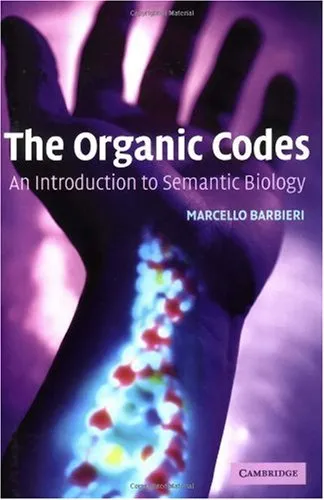
Welcome to the compelling narrative of "The Organic Codes: An Introduction to Semantic Biology," a book that eloquently bridges the disciplines of biology and semiotics. Written by Marcello Barbieri, this pioneering work introduces the foundational concept of organic codes, an idea that extends the traditional boundaries of biological sciences and ventures into the realm of meaning and information. It is a comprehensive guide designed to explore how nature, through the intricate dance of molecules and cells, produces language-like codes that are crucial for life.
Detailed Summary of the Book
In "The Organic Codes," Marcello Barbieri embarks on a journey to unravel the mystery of life by proposing a revolutionary concept: the existence of organic codes. These codes are crucial biological instructions that, akin to human languages, are governed by semantics. Unlike the traditional view that attributes life processes to mere mechanical functions of genes, Barbieri introduces the notion of natural conventions - comprehensive frameworks that translate molecular interactions into living phenomena.
Throughout the book, Barbieri argues that the genetic code itself is the first example of a natural language, a code with its own syntax and semantics that ultimately brought about the diversity of life forms. The book further discusses various examples of organic codes including the splicing codes, signal transduction codes, and compartment codes, each representing different dimensions of biological communication. By exploring these codes, Barbieri emphasizes a paradigm shift towards a more holistic understanding of life where meaning plays an essential role.
Key Takeaways
"The Organic Codes" offers several key insights:
- The proposal of organic codes as central to the understanding of life, bridging biology with the concept of meaning.
- The genetic code as the fundamental natural language of life, with properties akin to human languages.
- The notion that life is organized on multiple levels of code interpretation, from genetic to phenotypic manifestations.
- A shift in perspective viewing living systems as entities that not only process information but also possess inherent meaning and semantics.
Famous Quotes from the Book
"The history of life is first and foremost a history of organic codes.”
“The cell is not only the anatomical and functional unit of life, it is also the functional unit of meaning.”
Why This Book Matters
"The Organic Codes: An Introduction to Semantic Biology" is a groundbreaking text that challenges established assumptions in the field of biology. Barbieri offers a fresh perspective that not only advances scientific knowledge but also opens up a new dialogue between disciplines traditionally seen as vastly different. The book signifies an important shift towards integrating semiotics in biological research, ultimately advocating for a more nuanced understanding of life as inherently meaningful and communicative.
In an era where interdisciplinary approaches are increasingly necessary to tackle complex scientific questions, Barbieri’s work stands out as a crucial catalyst that invites us to view life through the lens of semantics, urging scientists and thinkers alike to reassess the fundamental principles that govern the living world.