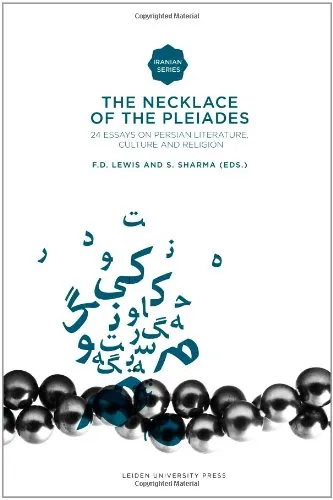
The Necklace of the Pleiades: 24 Essays on Persian Literature, Culture and Religion (Iranian Studies Series)
Franklin LewisandSunil Sharma (Editors)
2010
View book
Book guide and evaluation
Eric Heinze
0 reviews
Published
pages
views
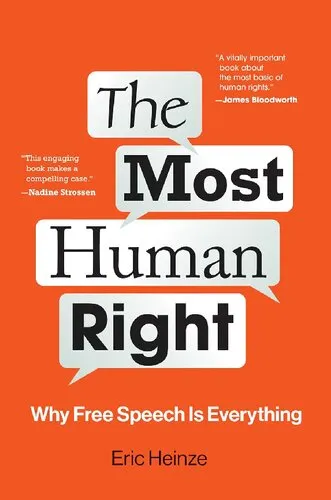
The Most Human Right: Why Free Speech Is Everything freedom of expression, human rights theory The Most Human Right: Why Free Speech Is Everything explores the vital link between free expression and all other human rights. Analytical Summary In The Most Human Right: Why Fre
Before you read
In The Most Human Right: Why Free Speech Is Everything, Eric Heinze delivers a compelling and rigorous examination of why free expression is not merely one among many liberties, but the essential gateway right upon which all other freedoms depend. Drawing from decades of experience in law, philosophy, and human rights scholarship, Heinze dissects the contemporary challenges to free speech, both in liberal democracies and in authoritarian contexts.
Far from treating freedom of expression in the abstract, the book situates it within real-world political, cultural, and legal landscapes. Heinze addresses contentious debates—from hate speech regulation to cancel culture—arguing that without a robust commitment to open discourse, societies erode the very foundation that enables accountability, equity, and justice. By framing free speech as the "most human" right, the book challenges readers to see it not just as a legal entitlement, but as an ethical and practical necessity.
The analysis is grounded in both historical precedent and contemporary case studies, providing critical insight relevant to academics, legal practitioners, policy-makers, and any reader deeply concerned about the trajectory of democratic societies. While the full publication history and any award recognitions are important for bibliographic completeness, information unavailable due to no reliable public source should be noted by the cautious reader. Such transparency underscores the scholarly integrity the book itself advocates in public discourse.
Heinze distills a series of persuasive and actionable ideas that clarify why freedom of expression must be protected even when it is uncomfortable or unpopular.
First, the book argues that free speech is not a luxury granted by stable societies—it is the mechanism that creates and sustains societal stability through dialogue and accountability. Second, Heinze emphasizes that restrictions on speech often harm marginalized groups more than they protect them, reversing their intended purpose. Third, the text shows how dismantling open discourse in the name of safety can paradoxically make societies less safe and more prone to abuse of power.
Additionally, the work challenges false equivalencies between speech that offends and speech that directly incites tangible harm, urging precise distinctions in law and policy. It concludes that defending even speech we despise is the truest test of our commitment to human rights, because only then do we affirm the equal moral agency of all individuals.
Several passages stand out for their clarity and conviction, crystallizing the book’s central arguments.
“Free speech is not the privilege of the powerful; it is the only guarantee that the powerless will be heard.” Unknown
“Silencing one voice diminishes the humanity of us all, for it erodes the shared ground of truth-seeking.” Unknown
“The test of a society’s moral confidence is whether it can bear to listen to those it most strongly rejects.” Unknown
The Most Human Right: Why Free Speech Is Everything arrives in a global context marked by rising disinformation, political polarization, and threats to democratic institutions. Its central thesis is that these challenges cannot be met by restricting expression, but by expanding and deepening it.
For scholars, this book provides a well-reasoned framework that links human rights theory directly to practical governance. For professionals in media, law, and policy, it offers a powerful reminder that suppressing speech rarely produces the justice or safety it promises. For engaged citizens, it serves as a call to guard the discursive spaces where society negotiates truth, rights, and mutual recognition.
In demonstrating that freedom of expression is the enabling right from which all others flow, Heinze shows why its erosion signals a deeper democratic malaise. At a time when discourse itself is under threat, the book’s insistence on principled, universal protections offers a pathway to more resilient societies.
By the close of The Most Human Right: Why Free Speech Is Everything, readers are left with both a renewed appreciation for the principle of open expression and a practical sense of how to defend it in their own spheres of influence.
Heinze’s work is more than an abstract defense of a legal principle; it is an invitation to participate actively in the democratic conversation. In defending free speech, we defend our shared humanity and our collective capacity to reason, reconcile, and progress.
Engage with this book not just as a reader, but as a contributor to the ongoing dialogue it champions. Read it, share its ideas, and discuss its implications widely. In doing so, you
Your question is answered in the context of this title and author. Each answer uses 2 points.
0 reviews, 4.9 average out of 5
Sign in to publish a review.
Ask a focused question and learn from the community.
Related references that continue this learning path.
Franklin LewisandSunil Sharma (Editors)