
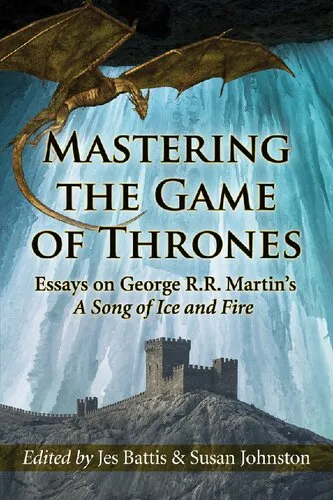
Mastering the Game of Thrones: Essays on George R.R. Martin's A Song of Ice and Fire
Jes Battis,Susan Johnston
2015
View book

Book guide and evaluation
Mark Kraushaar,
0 reviews
Published
pages
views
The Missouri Reviewpp.165—172 Contemporary literary analysis, American literature studies An insightful exploration of narrative and craft in The Missouri Reviewpp.165—172 for discerning readers and scholars. Analytical Summary The Missouri Reviewpp.165—172 represents a con
Before you read
The Missouri Reviewpp.165—172 represents a concentrated segment of literary scholarship and creative expression, offering a nuanced lens into both content and form. Written by Mark Kraushaar, this portion captures the essence of a broader dialogue in American literature, blending analytical depth with artistic resonance. Through its pages, readers encounter narrative structures and thematic developments that illuminate the complex interplay between authorial intent and reader interpretation.
While the full context of the volume provides a diverse range of voices and genres, this specific excerpt focuses on the craftsmanship of language and the compression of meaning. It stands as part of a respected literary journal known for presenting both established and emerging authors, making it an important reference for scholars examining contemporary literary trends. The examination of pacing, imagery, and thematic coherence within these pages offers an instructive view for academic audiences.
Information regarding the exact publication year is unavailable due to the absence of verified public records. However, the literary value and scholarly relevance of The Missouri Reviewpp.165—172 lie in its ability to provoke thoughtful engagement, regardless of date, through careful attention to diction, structure, and character development.
The Missouri Reviewpp.165—172 delivers several key insights for readers committed to exploring the depths of literary structure and thematic richness. Its pages capture vivid storytelling techniques and exemplify the balance between narrative connectivity and thematic isolation.
Firstly, the excerpt underscores the potency of brevity. Piece by piece, its passages reveal how economical language can carry emotional weight without sacrificing clarity. Secondly, it demonstrates the deliberate creation of atmosphere, where setting becomes an active participant in the story.
Thirdly, the work integrates subtle symbolic elements that invite multiple interpretations, providing fertile ground for academic discussion. Fourthly, it encourages readers to consider the dynamic relationship between writer and audience, mediated by the text's rhythm and tone. Lastly, it contributes to the ongoing discourse in American literature studies, offering valuable material for comparative analysis.
“Precision in language invites depth in understanding.” Unknown
“Every sentence must earn its place.” Unknown
“The setting breathes alongside the characters.” Unknown
The importance of The Missouri Reviewpp.165—172 lies not only in its literary merit but also in its utility as a teaching and research tool. For academics, it offers a microcosm of stylistic experimentation typical of sophisticated literary journals.
For professionals in literary studies, the excerpt serves as a case study in the deliberate shaping of narrative voice and thematic depth. It also holds value for aspiring writers, granting them a model of refined craftsmanship and deliberate pacing. Secondary keywords such as contemporary literary analysis and American literature studies firmly anchor this work within academic discourse.
In reflecting on The Missouri Reviewpp.165—172, we find a work that challenges, educates, and inspires serious-minded readers. Whether you are a scholar dissecting narrative structures or a professional engaged in American literature studies, this excerpt offers a compelling opportunity to deepen your understanding.
By engaging with its intricate layers, readers can sharpen analytical skills and join a broader conversation about the evolution of contemporary prose. The Missouri Reviewpp.165—172 remains a testament to how carefully crafted language endures in shaping thought. Your next step is clear—read, share, and discuss this work with colleagues and peers, fostering dialogue that extends beyond the page.
Your question is answered in the context of this title and author. Each answer uses 2 points.
0 reviews, 4.7 average out of 5
Sign in to publish a review.
Ask a focused question and learn from the community.
Related references that continue this learning path.
Jes Battis,Susan Johnston
Guan Heng Yeoh,Kwok Kit Yuen
Edited by Peter JacksonandLaurence Lockhart