
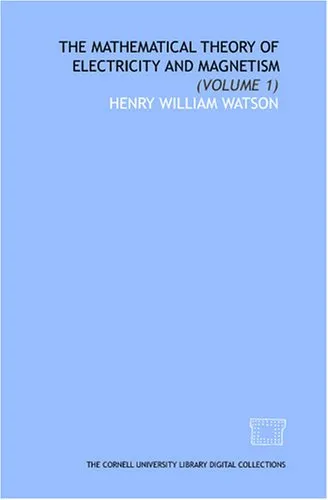
Book guide and evaluation
The mathematical theory of electricity and magnetism:
Henry William Watson
English
Beginner
Condensed Matter
3.8 / 5
0 reviews
1885
Published
320
pages
612
views
Welcome to 'The Mathematical Theory of Electricity and Magnetism,' a profound exploration into the entwined worlds of electromagnetic theory and mathematics. This book, authored by Henry William Watson, stands as a critical exposition on the intricacies of electricity and magne
Before you read
What will you get from this book?
Welcome to 'The Mathematical Theory of Electricity and Magnetism,' a profound exploration into the entwined worlds of electromagnetic theory and mathematics. This book, authored by Henry William Watson, stands as a critical exposition on the intricacies of electricity and magnetism conceived through the lens of mathematical principles. Designed for both scholars and enthusiasts, it delves into the fundamental aspects that define electromagnetic phenomena.
Detailed Summary of the Book
The book is structured to provide a comprehensive understanding of electricity and magnetism through a mathematical framework. It meticulously unpacks the foundations of electromagnetic theory, beginning with the basic principles of electrostatics. Readers are guided through a progression of concepts including electric fields, potential functions, and the laws governing electrical forces.
As the chapters advance, the book delves into magnetostatics and the characteristics of magnetic forces and materials. Mathematical rigor is applied to theories such as Ampère's Law and the Biot-Savart Law, providing learners with a structured approach to deriving and applying these principles in practical contexts.
Furthermore, the book transitions into dynamic electromagnetic phenomena, discussing Maxwell's equations and their implications in both theoretical and physical realms. It emphasizes the seamless integration of electricity and magnetism into a unified electromagnetic theory, highlighting the magnificence of these natural forces as one continuous entity.
Key Takeaways
- Understanding the mathematical principles underlying electrical and magnetic forces.
- Application of key laws and equations to solve complex electromagnetic problems.
- Insight into the evolution and unification of electromagnetic theory through Maxwell's equations.
- Critical analysis of the interconnections between theoretical constructs and real-world electromagnetic phenomena.
Famous Quotes from the Book
"To fully grasp the beauty of electromagnetic theory is to see the world not just as matter, but as a symphony of fields and forces interacting in harmony."
"Mathematics is the language nature uses to convey her secrets; electricity and magnetism are but chapters in an endless volume."
Why This Book Matters
This book holds a pivotal role in the academic and scientific landscape due to its deep and rigorous examination of electromagnetic theory through mathematical lenses. It serves as an essential resource for students, educators, and practitioners who aspire to understand or work within the realms of electrical engineering, physics, and applied mathematics.
'The Mathematical Theory of Electricity and Magnetism' lays the groundwork for future innovation and exploration in the fields of electromagnetics and technology. By equipping the reader with a robust mathematical foundation, it catalyzes further research and understanding in various scientific and practical applications, thus becoming instrumental in the progression of modern technology.
Ask this book
Your question is answered in the context of this title and author. Each answer uses 2 points.
Sign in to ask the book assistant.
Reader reviews
0 reviews, 3.8 average out of 5
No reviews yet
If you have read this book, help the next reader with your experience.
Write a review
Sign in to publish a review.
Reader questions and answers
Ask a focused question and learn from the community.
Sign in to ask or answer a question.
No questions yet
Be the first to ask a clear, useful question.
What to read next
Related references that continue this learning path.
Modern Many-Particle Physics: Atomic Gases, Quantum Dots and Quantum Fluids
Enrico Lipparini
2004
View book
Quantum Field Theory : Feynman Path Integrals and Diagrammatic Techniques in Condensed Matter
Fai,Lukong Cornelius
2020
View book