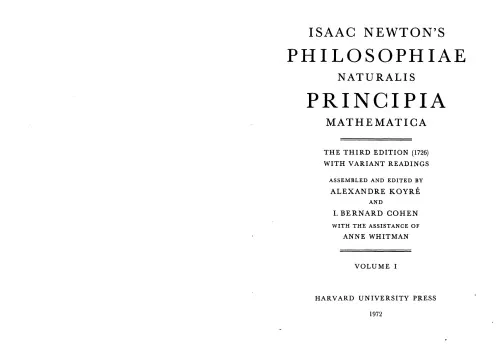
Isaac Newton's Philosoophiae naturalis Principia mathematica. The third edition with variant readings
Isaac Newton (auth.), Alexandre Koyré &I. Bernard Cohen (eds)
1972
View book
Book guide and evaluation
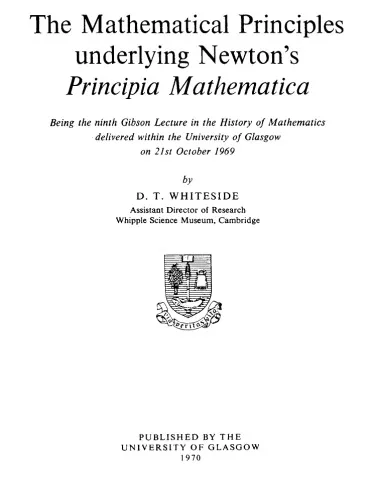
D.T. Whiteside
0 reviews
Published
pages
views
Introduction to "The Mathematical Principles Underlying Newton's Principia Mathematica" Isaac Newton's groundbreaking work, "Philosophiæ Naturalis Principia Mathematica," has profoundly influenced the scientific landscape. This book, "The Mathematical Principle
Before you read
Isaac Newton's groundbreaking work, "Philosophiæ Naturalis Principia Mathematica," has profoundly influenced the scientific landscape. This book, "The Mathematical Principles Underlying Newton's Principia Mathematica," delves deep into the mathematical foundations, logic, and principles that form the backbone of Newton's monumental text.
In this exploration, we aim to demystify the complexities of Newton's reasoning and highlight the rigorous mathematical framework that he employed. This book is crafted not only for scholars and historians of science but also for enthusiasts eager to grasp the profound principles that revolutionized our understanding of the universe. Through an engaging narrative and meticulous analysis, readers are guided through the intricacies of Newtonian mechanics, calculus, and the laws of motion that underpin the Principia.
Newton’s Principia Mathematica serves as the cornerstone of classical mechanics, and this book unravels its mathematical tapestry, presenting each chord in its rightful significance.
The narrative begins by setting the historical stage, detailing the challenges and astronomical questions faced by scientists in Newton's era. It proceeds to dissect Newton’s innovative use of calculus—then nascent and not yet formalized—to model gravitational forces and planetary motion. Each chapter is dedicated to exploring the axioms and propositions outlined in "Principia," providing mathematical proofs and interpretations accessible to modern readers.
The text progressively reveals Newton's Laws of Motion, the derivation of Kepler’s laws, and the pivotal calculus-based arguments supporting his gravitational theories. Emphasizing the beauty and precision of Newton's mathematical techniques, this book offers an indispensable insight into the logical structure that supports one of the greatest scientific works in history.
"In my attempt to illuminate the mathematical underpinnings of the Principia, I strive to shine a light on the remarkable synergy between calculus and celestial mechanics that Newton masterfully crafted."
"Understanding the essence of Newton's mathematical brilliance provides a window into the very nature of scientific revolutions."
This book serves as an essential resource for anyone interested in the intellectual leap forward heralded by the Principia.
By elucidating the mathematical principles that underlie Newton's work, this book not only celebrates the genius of Newton but also provides a historical and educational context for his innovations. It fosters a deeper appreciation of the mathematical ingenuity that fueled the scientific enlightenment and sheds light on the intricate relationships between motion, forces, and calculus that are still relevant in contemporary physics and engineering.
In an age where interdisciplinary understanding cultivates innovation, "The Mathematical Principles Underlying Newton's Principia Mathematica" stands as an invaluable cornerstone of knowledge, bridging history, science, and mathematics.
Your question is answered in the context of this title and author. Each answer uses 2 points.
0 reviews, 4.2 average out of 5
Sign in to publish a review.
Ask a focused question and learn from the community.
Related references that continue this learning path.
Isaac Newton (auth.), Alexandre Koyré &I. Bernard Cohen (eds)

Dobrzeniecki,Marek