Book guide and evaluation
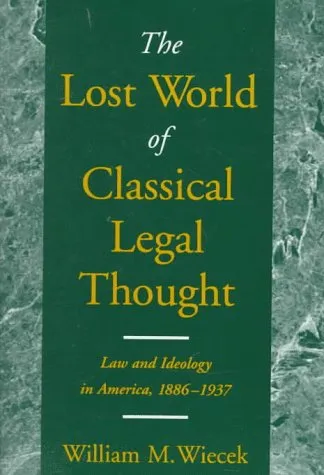
The Lost World of Classical Legal Thought: Law and Ideology in America, 1886-1937
William M. Wiecek
English
Intermediate
novel
4.0 / 5
0 reviews
1998
Published
297
pages
460
views
Overview Welcome to the realm of classical legal thought in America, a period often characterized by its profound influence on the perception and application of law between 1886 and 1937. This book, "The Lost World of Classical Legal Thought: Law and Ideology in America, 1886-
Before you read
What will you get from this book?
Overview
Welcome to the realm of classical legal thought in America, a period often characterized by its profound influence on the perception and application of law between 1886 and 1937. This book, "The Lost World of Classical Legal Thought: Law and Ideology in America, 1886-1937," invites readers to explore the intricate relationship between law and ideology during this transformative era.
Detailed Summary of the Book
Spanning over five decades, this book delves into the epoch known as the era of classical legal thought. During this time, legal formalism was at its zenith, emphasizing the logical and autonomous nature of the law. However, beneath this facade lay an ongoing struggle between tradition and progress. Legal formalism viewed law as a self-contained system, governed by principles of reason and logic, akin to mathematics. This philosophy dominated the legal landscape, influencing scholars, judges, and politicians.
Yet, as America transitioned into the twentieth century, challenges began to surface. The rapid industrialization, shifts in social norms, and economic upheavals questioned the rigidity and sufficiency of classical legal doctrines. The book examines how these tensions eventually led to the erosion of formalist dominance, giving rise to a more pragmatic and realistic approach towards legal thought. By exploring key legal cases, doctrinal debates, and the influence of towering legal figures, the book provides an in-depth analysis of how and why the classical legal thought paradigm eventually gave way to modern legal realism.
Key Takeaways
- The classical legal thought era was marked by a belief in law as a strict, autonomous discipline, immune to external social influences.
- Legal formalism promoted the idea that legal principles were eternal truths, unchanging over time and place.
- The book sheds light on the gradual shift towards legal realism, which recognized the importance of social context in shaping law.
- Many of today's legal practices and ideologies have roots in the debates and transformations that occurred during this period.
Famous Quotes from the Book
"In the space between public demands and judicial restraint, the law finds its true battlegrounds."
"Legal formalism, with its promise of a mechanistic and predictable legal order, faltered as society outpaced its rigid structures."
Why This Book Matters
The relevance of "The Lost World of Classical Legal Thought" extends beyond historical scholarship. This book provides a lens through which we can understand today's legal challenges and ideologies. In a rapidly changing world, it serves as a reminder of how past legal systems adapted—or failed to adapt—to societal needs and transformations. The debates and transitions discussed in this book continue to influence and inform contemporary legal theory and practice. By revisiting the assumptions and doctrines of classical legal thought, readers gain insights into the ongoing dialogue between law and society—a dialogue that remains central to current legal and political discourse.
Ask this book
Your question is answered in the context of this title and author. Each answer uses 2 points.
Sign in to ask the book assistant.
Reader reviews
0 reviews, 4.0 average out of 5
No reviews yet
If you have read this book, help the next reader with your experience.
Write a review
Sign in to publish a review.
Reader questions and answers
Ask a focused question and learn from the community.
Sign in to ask or answer a question.
No questions yet
Be the first to ask a clear, useful question.
What to read next
Related references that continue this learning path.