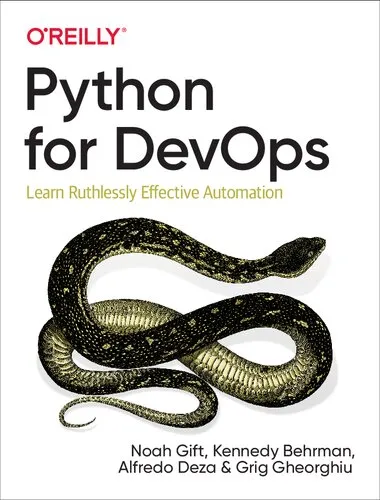
Python for DevOps: Learn Ruthlessly Effective Automation
Noah Gift,Kennedy Behrman,Alfredo Deza,Grig Gheorghiu
2020
View book
Book guide and evaluation
William E. Shotts,Jr.
0 reviews
Published
pages
views
The Linux® Command Line: A Comprehensive Introduction Welcome to the journey of mastering the Linux command line, a powerful tool for harnessing the full potential of your operating system. This introduction aims to provide an in-depth overview of the book "The Linux® Command
Before you read
Welcome to the journey of mastering the Linux command line, a powerful tool for harnessing the full potential of your operating system. This introduction aims to provide an in-depth overview of the book "The Linux® Command Line," highlighting its significance and value to both new and experienced users of Linux.
The book "The Linux® Command Line" offers a comprehensive guide to understanding and mastering the Linux command line, an essential skill for anyone involved in computing and technology. It starts with the basics, introducing the Unix philosophy that drives Linux and gradually progresses to more advanced topics, covering a wide range of commands and their practical applications.
The initial chapters are dedicated to acquainting readers with the terminal interface and basic shell commands. As you delve deeper, the book explores powerful shell scripting techniques, providing readers with the skills to automate complex tasks and enhance their workflow efficiency. An emphasis is placed on not just memorizing commands, but truly understanding their contextual application in problem-solving.
In further chapters, the book covers important topics like file manipulation, text processing, and networking, alongside practical examples and exercises. The sections on bash scripting are particularly detailed, equipping readers with the ability to create robust, reusable scripts that solve real-world problems.
"The command line is the beating heart of Linux; a place to issue instructions and interact with the system at a level that graphic interfaces can never reach."
"Knowing the shell commands forms the basis upon which the understanding of more complex concepts is built."
In today's technological landscape, Linux is pervasive, forming the backbone of countless systems and technologies. Mastering the command line is crucial for software developers, system administrators, and technology enthusiasts. This book matters because it not only equips readers with the technical skills necessary for interacting with Linux but also with a mindset that values simplicity, efficiency, and the power of open-source philosophy.
The book shines in its ability to make complex topics accessible, demystifying the intimidating aspects of the command line for beginners while still offering depth and insight for seasoned users. By fostering a deep understanding of the Linux environment, "The Linux® Command Line" helps readers become more adept and confident users, capable of contributing to the Linux community and leveraging the system's full capabilities.
In conclusion, "The Linux® Command Line" is more than just a technical manual; it's a resource that empowers individuals to explore, learn, and grow within the Linux ecosystem.
With this book as your guide, embark on a transformative journey through the intricacies and wonders of the Linux command line.
Your question is answered in the context of this title and author. Each answer uses 2 points.
0 reviews, 4.7 average out of 5
Sign in to publish a review.
Ask a focused question and learn from the community.
Related references that continue this learning path.
Noah Gift,Kennedy Behrman,Alfredo Deza,Grig Gheorghiu