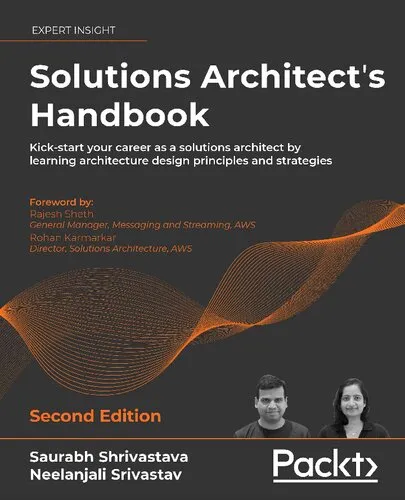
Solutions Architect's Handbook: Kick-start your career as a solutions architect by learning architecture design principles and strategies, 2nd Edition
Saurabh Shrivastava,Neelanjali Srivastav
2022
View book
Book guide and evaluation
Kashyap, Ravi
0 reviews
Published
pages
views
The Journal of Private Equitypp.45—63 private equity analysis, investment strategy insights The Journal of Private Equitypp.45—63 offers in-depth perspectives on private equity trends, strategies, and research. Analytical Summary The Journal of Private Equitypp.45—63 repres
Before you read
The Journal of Private Equitypp.45—63 represents a focused segment of a respected academic and professional periodical, offering rigorous explorations into the evolving landscape of private equity. Assembling a blend of scholarly research and practical investment discourse, this section serves as a bridge between theoretical frameworks and the real-world complexities of the private markets.
The focus of pages 45–63 dives into case studies, market trend analyses, and evaluations of emerging investment channels. The discussions incorporate data-driven assessments and contextualize them against macroeconomic shifts, regulatory climates, and capital market movements. For academics, this ensures methodological reliability; for professionals, it delivers actionable intelligence anchored in credible research practices.
While the exact publication year for this excerpt remains information unavailable due to the absence of a reliable public source, the analytical scope remains timeless in its utility. It navigates core private equity themes—deal structuring, risk assessment, portfolio optimization—while reflecting on the dynamic interplay between investor expectations and operational realities.
Readers will emerge from The Journal of Private Equitypp.45—63 with sharpened analytical tools and a nuanced understanding of how private equity strategies adapt to market conditions.
First, the segment underscores the indispensability of due diligence—not merely as a procedural step, but as a strategic posture integral to long-term portfolio health. Second, it clarifies the necessity of aligning investment horizons with sector-specific cycles, recognizing that value creation timelines vary significantly across industries.
The section also highlights the growing relevance of sustainable investing principles within private equity, demonstrating that environmental, social, and governance (ESG) criteria can coexist—and even synergize—with profit objectives. Lastly, it offers a critical look at risk mitigation strategies in light of geopolitical uncertainties and shifting capital flows.
"In private equity, the true asset is not just capital—it's informed conviction." Unknown
"Market cycles are inevitable; intelligent structuring is optional—but indispensable." Unknown
"Private equity is less about chasing returns and more about engineering them." Unknown
In an era of rapid capital market innovation, The Journal of Private Equitypp.45—63 holds significant relevance for both theory-building and practical application.
For the academic reader, it provides source material that can inform curriculum development, scholarly debate, and longitudinal sector studies. For industry practitioners, it delivers a concentrated dose of expertise that can sharpen decision-making in deal sourcing, fund management, and value enhancement.
The integration of secondary keywords such as private equity analysis and investment strategy insights further cements its position as a critical resource for those who seek to not only understand but also shape the future of private equity landscapes.
The Journal of Private Equitypp.45—63 stands as both a detailed reference and an invitation to engage more deeply with the art and science of private equity investing.
Whether you are an academic aiming to expand the intellectual boundaries of the field, or a professional seeking to refine your investment strategy insights, this work offers a compact yet potent repository of knowledge and analysis. It proves that in the private markets, informed perspectives are as valuable as capital itself.
Your next step is simple: dive into its pages, reflect on the frameworks presented, and share your perspectives with peers. In doing so, you contribute to a richer and more resilient discourse in the ever-evolving world of private equity.
Your question is answered in the context of this title and author. Each answer uses 2 points.
0 reviews, 4.9 average out of 5
Sign in to publish a review.
Ask a focused question and learn from the community.
Related references that continue this learning path.
Saurabh Shrivastava,Neelanjali Srivastav

Saurabh Shrivastava,Neelanjali Srivastav